Toggle navigation

SUCCESS!
We look forward to helping you advance your career as a travel nurse!

By: Kathleen Gaines MSN, BA, RN, CBC
The Rocky Mountains are calling all travel nurses. Colorado, with its vivid and dynamic landscapes, offers endless possibilities for outdoor adventures on your days off. Colorado has mountains, forests, high plains, mesas, canyons, plateaus, rivers, and desert lands. Colorado is especially popular for its ski slopes – ideal for those wintertime travel assignments.
But even if you are not into the great outdoors, Colorado also is known for being home to more than 400 established microbreweries producing some of the best craft beers in the country.
If you are ready for an adventure – Colorado might be the state for you. Keep reading to find out more!
Looking for open travel nurse assignments in Colorado? Speak with a recruiter today!
According to the U.S. Bureau of Labor Statistics (BLS), nurses in Colorado earn an average annual salary of $80,670 which is higher than the national average of $77,600. The compensation for travel nurses is directly reflective of this as well as the ongoing need for nurses. Therefore, it is one of the highest-paying states for travel nurses.
Indeed.com reports an average base salary of $2,156 per week, with top locations in Pueblo, Wheat Ridge, Denver, Aurora, and Englewood.
| Hourly Wage | Weekly Wage | Monthly Wage | |
| Pueblo | $62.84 | $2,683 | $10,381 |
| Wheat Ridge | $59.48 | $2,539 | $9,827 |
| Denver | $58.74 | $2,508 | $9,705 |
| Aurora | $56.15 | $2,397 | $9,276 |
| Englewood | $53.90 | $2,301 | $8,904 |
The highest-paid travel nursing specialties depend on a variety of factors including location within the state, demand, and urgency of needs. The demand for travel nurses in Colorado has always been high, causing the pay to be above average. Furthermore, Colorado has a high influx of visitors during the summer due to its breathtaking national parks and during the winter due to the winter ski season in the mountains.
As a result of the increased demand for nurses, wages that are being offered are steadily increasing. Unfortunately, this is not being seen across all disciplines of nursing.
Medical surgical nurses, long-term care nurses, and clinic nurses will see significantly lower rates than other specialties, but this is generally the case even for staff nurses. Increased certifications, credentials, and skills will command higher pay.
Historically speaking, the top-paying travel nurse specialties are:
According to Vivian.com, the top-paying specialties for travel nurses in Colorado are:
Colorado has 105 hospitals. Twelve meet the high U.S. News standards. According to U.S. World News and Report, these hospitals were evaluated and ranked. The top five hospitals in Colorado for 2023 are as follows:
Find open positions today for your specialty.
As the national cost of living continues to rise, Colorado is also seeing a significant rise in the cost of living. In fact, an ongoing issue for travel nurses is finding affordable housing during contracts. There have been many reports of travel nurses not being able to find housing until days before or even days after a contract starts.
Despite all travel nurse companies providing a stipend for housing, at times it is not enough. Furthermore, depending on the location, hotels may not be a viable long-term solution. Travel nurses have resorted to utilizing alternative websites such as Airbnb and Furnished Finders to find housing while traveling.
Cost of living is defined as the amount of money needed to cover basic expenses such as housing, food, taxes, and healthcare. According to Bestplaces.net, Colorado’s overall cost of living is 20.5% higher than the U.S. average. Let’s take a look at some of Colorado’s top cities:
| National Average | Median Home Price | Median Rent | Average Energy Bill | |
| Aurora | 7% higher | $435,915 | $1,332 | $140.25 |
| Denver | 14% higher | $550,978 | $1,683 | $140.25 |
| Colorado Springs | 8% higher | $461,737 | $1,411 | $169.08 |
| Wheat Ridge | 4% higher | $443,746 | $1,356 | $140.25 |
| Green Mountain Falls | 4% higher | $410,721 | $1,255 | $169.08 |
A great resource to calculate your current salary and town versus a city in Colorado is CNN’s Cost of Living Calculator.
With any career, there are pros and cons to the job. Travel nursing is no different. It’s important to take into consideration your own personal circumstances, family obligations, and reasons for wanting to be a travel nurse. Reasons that some nurses might see as a con may in fact be a positive for you.
Travel nurses have the ability to earn significantly more money than staff nurses. Furthermore, they can make more due to reimbursements and incentives, which can be earned tax-free. Most travel nurses receive free housing or have a hefty monthly allowance to put toward housing expenses.
One of the main reasons travel nurses start this adventure is to experience different cities and states they may not otherwise get to experience. It also is great for nurses that are not sure where they ultimately want to settle down.
You have the ability to take a contract when you want to and where you want. If you really want to travel to Colorado, you have the ability to find a nursing contract that fits your needs. It is also easier to get a permanent staff position if there is a hospital that you eventually want to work at.
Most don’t consider this a huge pro of travel nursing, but it is! With an increase in the number of nurses that go on for an advanced degree, making connections with different hospitals, providers, and nurses can be very important when trying to find preceptors for graduate-level clinical rotations.
Most don’t like to admit it, but bedside nursing comes with drama and politics. It can be as simple as a hierarchy based on seniority or something more serious. Being a travel nurse allows you to avoid all of this by not being fully invested in the unit but instead helping out for a very specific amount of time.
Being new to a unit can be exciting but can also be frustrating or even lonely. Not knowing anyone on the unit can affect the type of help you will get in your work environment.
Some hospitals will assign travel nurses patients just like any other nurse on the unit. Others will assign them the easiest patients, the hardest patients, or the ones that no one wants to deal with.
Despite being contracted to a specific unit, most travel nurses will have to float to other parts of the hospital within their skill set. This again will make you the new person which can affect how others perceive you as well as assist you throughout the shift
All travel nurse companies offer their nurses places to live during each contract. However, it is not always in the location that you want, has the amenities you desire, and/or fits your needs. Additionally, if the agency places you in housing, you won’t be offered the housing stipend. Contracts that offer a housing stipend instead, which most travel nurses take, leave the responsibility of finding appropriate housing to you.
With each contract may come a new health insurance policy. This will be dependent on the agency that you work with. If you switch between multiple agencies, then there will most likely be a lapse in your health insurance. However, nurses can opt for private insurance and pay out of pocket. That way, when the assignment ends, you won’t lose your insurance.
The are countless reasons why you should find a travel nursing position in Colorado. First, Colorado is part of the eNLC (Enhanced Nursing Licensure Compact). The eNLC allows nurses to hold one license to practice in participating states without having to pay additional licensing fees. For those nurses that hold primary residence in an eNLC state, traveling to Colorado can be simple. As a non-resident of an eNLC state, you can apply for licensure by endorsement but will only be issued a single-state license instead of the compact license. Nurses can hold multiple single-state licenses.
Colorado continues to see growth in the travel nursing market. A 2021 study found that while Colorado currently has a nursing gap of around 2,600 nurses, that number will grow to a projected gap of more than 10,000 nurses by 2026. Beyond the needs at the bedside, travel nurses in Colorado can expect adventure in both the summer and winter.
Find available, high-paying travel nurse opportunities.
Travel nursing in Alaska is a dream for most. The northern lights, midnight sun, Denali National Park, and the sheer beauty of the unknown attract hundreds of travel nurses each year. Alaska offers something for everyone, including nature lovers, with outdoor adventures as well as the hustle and bustle of city life.
If you are ready for an adventure to The Last Frontier then Alaska might be the state for you. Keep reading to find out more!
Speak with a recruiter about travel nursing assignments in Alaska!
COVID & travel nurses in Alaska
As of January 2022, the Alaska Department of Health and Social Services has reported 1,113 deaths due to COVID-19 since the start of the pandemic. For this same period, the US death cumulative incidence was 268 per 100,000 persons, which was approximately 1.8 times higher than the Alaska death rate. Of these 1,113 deaths, 864 (77.6%) were known to have been hospitalized and 324 (29.1%) were admitted to an intensive care unit.
According to statistics, as of January 2022, the state of Alaska is seeing a disparity between age, race, and ethnicity in regard to infection numbers.
Ethnicity and Race:
Sex:
Age:
In Alaska, 69% of the state’s overall population has received at least one dose of the vaccine while 61% of the population is considered fully vaccinated. Furthermore, 26% have received a booster dose.
Alaska has always been very popular with travel nurses partially because there is a very large need for nurses throughout the state. The Alaska State Hospitals and Nursing Home Association recently completed an Alaska Healthcare Workforce Analysis and found there were 1,400 positions available for registered nurses. Approximately 11.3% of healthcare workers in Alaska come from out of state.
“This is the biggest challenge, I would say, facing health care into the foreseeable future,” association President and CEO Jared Kosin said in regard to the workforce shortage. Throughout the COVID pandemic, the need was so high in Alaska that the governor signed multiple contracts to bring in large numbers of nurses. In September 2021, 500 travel nurses were brought in specifically to help overworked healthcare workers and stressed healthcare systems.
How much do travel nurses make in Alaska?
According to ZipRecruiter, travel nurses make an average of $80,207 per year with a range of $61,822 to $105,696 per year.
Indeed reports an average base salary of $1,981 per week with top locations in Cordova, Juneau, Anchorage, and Fairbanks.
Looking for travel nurse assignments in Alaska? Speak with a recruiter today!
Highest paying nursing specialties in Alaska
The highest-paid travel nursing specialties depend on a variety of factors including location within the state, demand, and urgency of needs. The demand for travel nurses in Alaska has always been high but it also is one of the most requested states by travel nurses.
As a result of the increased demand for nurses and the ongoing pandemic, wages that are being offered are steadily increasing. Unfortunately, this is not being seen across all disciplines of nursing.
Historically speaking the top paying travel nurse specialties are:
According to SimplyHired, intensive care unit, labor and delivery, and operating room nurses have the highest earning potential in Alaska. Potential average annual salaries include:
Top 5 hospitals in Alaska
Alaska’s population is more spread out than any other state in the country, with fewer than one million residents as of 2019. U.S. World News and Report ranked and evaluated Alaska’s 26 hospitals, and the top five as of 2021-2022 were:
Cost of living for travel nurses in Alaska
As the national cost of living continues to rise, Alaska’s cost of living has remained fairly consistent because of its isolated location. Cost of living is defined as the amount of money needed to cover basic expenses such as housing, food, taxes, and healthcare.
Typically, the cost of living is less in smaller towns than in major cities; however, in Alaska, this is not the case. Because of the isolation and distance, smaller cities in Alaska can be more expensive than large cities such as Fairbanks and Juneau.
According to BestPlaces, the overall cost of living in Alaska rates 125.8. The number is well above 100 which means Alaska has a significantly higher cost of living than the U.S. average. The median house cost is $293,400 as compared to the median home cost in the U.S. of only $291,700.
Payscale.com reports on the cost of living in major Alaska cities including the median home price, median rent, and monthly energy bill.
A great resource to calculate your current salary and town versus a city in Alaska is CNN’s Cost of Living Calculator.
Pros & cons of travel nursing in Alaska
With any career, there are pros and cons to the job. Travel nursing is no different. It’s important to take into consideration your own personal circumstances, family obligations, and reasons for wanting to be a travel nurse. Reasons that some nurses might see as a con may in fact be a positive for you.
Pros
1. Increased earning potential
Travel nurses have the ability to earn significantly more money than staff nurses. Furthermore, they can make more due to reimbursements and incentives. Most travel nurses receive free housing or have a monthly allowance to put toward housing expenses.
2. Travel
One of the main reasons travel nurses start this adventure is to experience different cities and states they may not otherwise get to experience. It also is great for nurses that are not sure where they ultimately want to settle down.
3. Flexibility
You have the ability to take a contract when you want to and where you want to. If you really want to travel to Alaska you have the ability to find a contract that fits your needs.
4. Networking
Most don’t consider this a huge pro of travel nursing but it is! With an increase in the number of nurses that go on for an advanced degree, making connections with different hospitals, providers, and nurses can be very important when trying to find preceptors for graduate-level clinical rotations.
5. Avoid hospital and unit politics
Most don’t like to admit it but bedside nursing comes with drama and politics. It can be as simple as a hierarchy based on seniority or something more serious. Being a travel nurse allows you to avoid all of this as you’re not fully invested in the unit and only helping out for a very specific amount of time.
Cons
1. Always the new person
Being new to a unit can be exciting but can also be frustrating or even lonely. Not knowing anyone on the unit can affect the type of help you will get in your work environment.
2. Not the best assignments
Some hospitals will assign travel nurses patients just like any other nurse on the unit. Others will assign them the easiest patients, the hardest patients, or the ones that no one wants to deal with.
3. First to float to another unit
Despite being contracted to a specific unit, most travel nurses will have to float to other parts of the hospital within their skill set. This again will make you the new person which can affect how others perceive you as well as assist you throughout the shift
4. Finding a place to live
All travel nurse companies offer their nurses places to live during each contract. However, it is not always in the location that you want, has the amenities you desire, and/or fits your needs. Contracts will offer a housing stipend instead, which most travel nurses take, but then finding appropriate housing falls on you.
5. Changing health insurance policies
With each contract may come a new health insurance policy. This will be dependent on the agency that you work with. If you switch between multiple agencies then there will most likely be a lapse in your health insurance. However, nurses can opt for private insurance and pay out-of-pocket. That way, when the assignment ends, you won’t lose your insurance.
Why Alaska?
Alaska is The Last Frontier and draws adventures, wanders, and travel enthusiasts. More importantly, it attracts travel nurses wanting to experience the great unknown. Alaska is a very large state and much of the population is widespread and even isolated. Communities are without healthcare and there are major gaps in availability. Travel nurses help fill these gaps.
While the cost of living might be slightly higher than in other states, the higher hourly wages can make up the difference. With an ongoing high demand for travel nurses of all specialties and very competitive wages, Alaska is a great fit for anyone interested in becoming a travel nurse.
Speak with a recruiter about available travel nursing assignments in Alaska!
Travel nursing is an exciting opportunity to see parts of the United States while making some serious money. California — one of the most sought-after states because of the diverse culture, fun outdoor activities including swimming in the Pacific Ocean or sipping wine in the Napa vineyards — is the ideal place to take a travel nursing assignment.
This guide will help you learn more about travel nursing in California and why it might be a great fit for you!
Speak with a recruiter about available travel nursing assignments in California!
As of December 3, 2021, the Centers for Disease Control and Prevention (CDC) have reported a minimum of 7,612 new cases per day.
California has been particularly hard hit with COVID cases, especially during the surge from the Delta variant. As a result, news reports indicate that more than ever, California is relying on travel nurses to fill the staffing shortage and help relieve overwhelmed hospitals. Furthermore, the Omicron variant has now been detected in California which could continue to strain hospitals and healthcare systems.
Currently, there is a shortage of 40,567 full-time RNs, which is projected to persist until 2026, according to an analysis of preliminary data from the 2020 Survey of California Registered Nurses and final data from the 2019-20 Annual RN Schools Survey.
According to ZipRecruiter, the top locations for travel nurses are Los Angeles, San Francisco, San Diego, and Sacramento.
The highest-paid travel nursing specialties depend on a variety of factors including location, demand, and urgency of needs. Right now, the demand for travel nurses in California is extremely high due to COVID and crisis contracts. As a result, the wages that are being offered are steadily increasing. Unfortunately, this is not being seen across all disciplines of nursing.
Historically speaking, the top paying travel nurse specialties are,
With COVID, the top paying travel nurse jobs have changed and are based on location more so than position.
According to ZipRecruiter, the following cities have these top-paying specialties:
Looking for travel nurse assignments in California? Speak with a recruiter today!
With more than 39.51 million residents in 2020, California is the most populous U.S. state in population. California’s population is projected to reach 45 million people by 2050. With such a large population, California has multiple cities with over a million residents including Los Angeles, San Diego, and San Jose.
U.S. World News and World Report evaluated 416 hospitals in California. The top five hospitals in California as of 2020 were:
As the national cost of living continues to rise, California has continued to see a dramatic increase in the cost of living. In fact, the cost of living in California has always been one of the highest in the country. Cost of living is defined as the amount of money needed to cover basic expenses such as housing, food, taxes, and healthcare.
The cost of living is always higher in larger cities than smaller towns, therefore housing will cost more in Los Angeles and San Francisco.
According to Bestplaces.net, the overall cost of living in California rates 149.9. The number is well above 100, which means California’s cost of living is significantly higher than the U.S. average. The median house cost is $684,800 as compared to the median home cost in the U.S. as a whole ($291,700).
Payscale.com reports on the cost of living in major California cities including the median home price, median rent, and monthly energy bill.
A great resource to evaluate how far a salary will stretch in a given city is CNN’s Cost of Living Calculator.
With any career, there are pros and cons to the job. Travel nursing is no different. It’s important to take into consideration your own personal circumstances, family obligations, and reasons for wanting to be a travel nurse. Reasons that some nurses might see as a con may in fact be a positive for you.
California is a great state with sunny weather, diverse food, a rich cultural scene, pristine beaches, vibrant nightlife, mountains, and vineyards as far as the eye can see.
With an ongoing high demand for travel nurses of all specialties at very competitive wages, California is a great fit for anyone interested in becoming a travel nurse. Whether it is your first contract or your fifteenth, California has something to offer anyone willing to explore!
Speak with a recruiter about available travel nursing assignments in California!
Travel nursing is an exciting opportunity to travel the country while working in the nation’s top hospitals, but figuring out nursing license requirements for each state can be overwhelming.
The good news: The National Council of State Boards of Nursing (NCSBN) developed the Nursing Licensure Compact (NLC), which is an agreement between states that allows nurses to have one license and the ability to practice in all the states that participate in the program.
RNs can earn up to $2,300 a week as a travel nurse. Speak to a recruiter today!
The Nursing Licensure Compact (NLC) has been around since 2000, but was updated in 2018 to the Enhanced Nursing Licensure Compact (eNLC) and includes standards for licensure, which the original compact license lacked. The eNLC allows nurses to hold one license to practice in participating states without having to pay additional licensing fees.
Currently, 30 states participate in the eNLC. In order to be eligible for a multi-state nursing license a nurse must have:
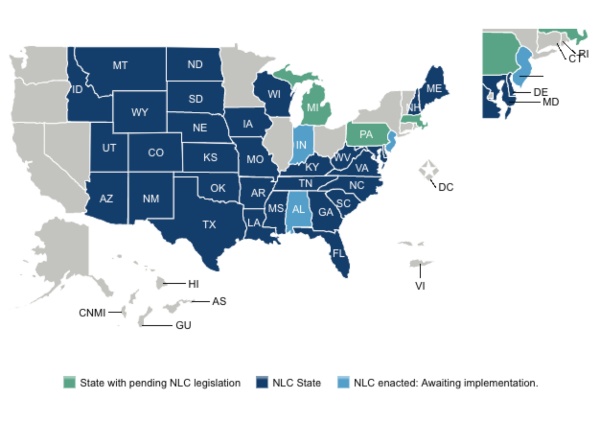
Source: National Council of State Boards of Nursing (NCSBN) 2019
You must claim residency in an eNLC participating state in order to apply for a compact license. (Your primary residence refers to the state where you file your tax returns, vote, and/or have a driver’s license.) As a non-resident of an eNLC state, you can apply for licensure by endorsement, but will only be issued a single-state license instead of the compact license. Nurses can hold multiple single-state licenses.
This may be confusing, so here are a couple examples:
Example #1: A nurse has primary residence and obtained their license in the state of Colorado, but wants to take a travel nursing job in Arizona. Because Colorado and Arizona both participate in the eNLC, there is no need to obtain an additional nursing license — the nurse can start the position in Arizona immediately. (The nurse’s current licensing information is confirmed by the employer from a national database known as Nursys and the nurse is required to complete a criminal background check and fingerprinting for the state of Arizona.)
Example #2: A nurse has primary residence and licensure in Kentucky, but wants to take a travel nursing job in Alaska. Kentucky participates in the eNLC, but Alaska does not. The nurse must obtain a single-state license for Alaska before starting their assignment.
Pro tip: If you know the specific state you’d like to travel to, then visit its state board of nursing website or ask your recruiter about licensing in that state specifically.
Travel nurse staffing agencies may refer to some states as “walk-through states,” which refers to states that issue licensure by endorsement or “temporary licenses.” Temporary licenses are mainly used for nurses who are looking to move to another state or have accepted a job and are waiting for their permanent licensing application to be processed. These types of licenses are often used during nursing strikes too. For example, obtaining a license in California can take several months, but temporary licenses are processed more quickly, so demand for nurses during strikes can be met.
Read more: Crossing the Picket Line as a Travel Nurse
Temporary licenses are typically good for 30 days to six months. If the nursing assignment is longer than the length of the temporary license, then a permanent license is required. Temporary licenses can only be obtained once per state and not all states allow temporary licenses.
Current “walk-through” states include:
The licensing fee and requirements for licensure by endorsement and permanent licensing are similar. Those fees and requirements include:
Note: Some states also require two letters of reference and proof of work history when applying for licensure by endorsement.
Travel nursing agencies typically do not pay for nursing licenses or license renewals. They will often assist in the process though, and may even submit the paperwork.
While individual state nursing boards do not require certifications such as Basic Life Support (BLS) and Pediatric Advanced Life Support (PALS), hospitals do require nurses have these certifications. That means travel nurse staffing agencies will require that these certifications be up to date before submitting your travel nurse contract to a hospital.
The cost of licenses can add up quickly for travel nurses especially when working in states that don’t participate in the eNLC.
Pro tip: Somes states allow nurses to suspend their license for a nominal fee; to reinstate the license, it’s another small fee.
For example, if a nurse holds a primary nursing license in Washington and wants to take a travel nursing assignment in Oregon (neither of which participate in the eNLC), then they must apply for a permanent license in Oregon. To obtain a single-state license, the nurse must fill out an application, pay the licensing fees, and complete a background check and fingerprinting — this process may take several weeks.
If the same nurse wants to renew their Oregon license after two years, then they must complete the required continuing education hours and pay the renewal fees. Technically, this nurse should also maintain their Washington nursing license too as it’s their primary residence. This means paying the renewal fees and completing any continuing education requirements for Washington as well.
Obtaining a nursing license can be as quick as two days in states like Hawaii or as long as six months in California or Ohio. (California and Ohio currently have the longest wait times for a permanent license.) Travel nurses may have to take contracts in other states while they wait for their license to be approved. It’s important to plan ahead if there are non-compact states on your desired list of places to travel. Typical wait times for nursing licenses for non-compact states:
If working as a travel nurse and figuring out licensing still seems daunting, don’t fret. Travel nurse agencies and recruiters are knowledgeable on the topic and in some states can help nurses expedite the licensing process.
Nurses with compact licenses have increased flexibility and can start new contracts immediately in other compact states with minimal paperwork and fees. This opens the door for more employment opportunities for nurses. The impact of the eNLC extends beyond the flexibility for nurses, though. It also increases the access to care for patients and allows hospitals to hire the best nurses for a position by removing the limitation of geographical licensures.
If you’re considering travel nursing, then ensure your license is up to date and get ready for your next adventure.
Speak to a recruiter today to find travel nursing assignments near you!
Travel nursing is an exciting opportunity to see parts of the United States while making some serious money. Prior to COVID, New York was one of the most sought-after states for travel nursing. However, working conditions throughout COVID changed the perception of nursing in New York, especially New York City.
Travel nursing in New York is still one of the most sought after, not because of the ideal working conditions, but rather for the extremely high pay and countless travel nurse opportunities.
Major cities such as New York City, Buffalo, Albany, and Rochester attract nurses who want to enjoy the nightlife in the city or a slower pace of life in the suburbs. This guide will help you learn more about travel nursing in New York and why it might be a great fit for you!
Speak with a recruiter about available travel nursing assignments in New York!
As of December 3, 2021, the Centers for Disease Control and Prevention (CDC) have reported a minimum of 8,853 new cases per day in New York, excluding NYC. New York City on the other hand reported 2,050 new cases.
Since the start of the pandemic, there have been 2,734,874 positive COVID cases in New York and 57,491 deaths. The largest number of reported cases is in Kings County with approximately 344,326 positive COVID cases and 10,972 deaths. Reports indicate that 68.69% or 13,361,820 people are fully vaccinated with the Moderna, Pfizer, or Johnson and Johnson vaccines.
New York, especially New York City, was the epicenter of COVID at the start of the pandemic. The numbers only continued to surge as the delta variant spread across the state. New York relied heavily on travel nurses, more specifically crisis nurses, throughout the initial wave of COVID.
More than ever, New York is relying on travel nurses to fill the staffing shortage and help relieve overwhelmed hospitals.
More than ever, New York is relying on travel nurses to fill the staffing shortage and help relieve overwhelmed hospitals. Furthermore, the Omicron variant has now been detected in New York, which could continue to strain hospitals and healthcare systems.
By 2030 there is a projected shortage of more than 39,000 registered nurses (RN) in New York, according to a report put out by the New York State Department of Health (DOH) in August 2020.
“As healthcare systems struggle to meet new recruitment and retention challenges, they are also struggling to meet the high patient volume we are seeing from our communities. Many healthcare systems have been forced to rely on external sources such as agencies to fill the gaps caused by staffing shortages. This places a significant strain on today’s healthcare system,” said a St. Peter’s Health Partners spokesperson.
According to ZipRecruiter, the top locations for travel nurses are New York City, Staten Island, Manhattan, and Poughkeepsie. It’s important to remember that these hourly wages have been affected by the crisis pay that was readily available throughout the initial wave of the pandemic.
The highest-paid travel nursing specialties depend on a variety of factors including location, demand, and urgency of need. Right now, the demand for travel nurses in New York remains extremely high due to COVID and crisis contracts. As a result, the wages that are being offered are steadily increasing. Unfortunately, this is not consistent across all disciplines of nursing.
It’s important to remember why the rates for travel nurses are being offered. A large number of healthcare workers left the bedside during the pandemic and continue to do so. Furthermore, due to repeated exposure at the start of the pandemic and lack of proper personal protection equipment (PPE) a large number of nurses lost their lives to COVID. This further increases the need for travel nurses in New York.
Historically speaking, the top paying travel nurse specialties are:
With COVID, the top paying travel nurse jobs have changed and are based on location more so than position.
According to ZipRecruiter, the following cities have these top-paying specialties:
Looking for travel nurse assignments in New York? Speak with a recruiter today!
With more than 20.2 million residents in 2020, almost half of the state’s population lives in New York City. Interestingly, New York City has more people than 40 of the 50 U.S. states.
According to U.S. World News and Report, 210 hospitals were evaluated in New York. The top five hospitals in New York as of 2020 were:
As the national cost of living continues to rise, New York has continued to see a dramatic increase in the cost of living. In fact, the cost of living in New York has always been one of the highest in the country. Cost of living is defined as the amount of money needed to cover basic expenses such as housing, food, taxes, and healthcare.
The cost of living is always higher in larger cities than smaller towns so housing will cost significantly more in New York City.
According to Bestplaces.net, the overall cost of living in New York rates 120.5. The number is well above 100 which means New York is significantly more than the U.S. average. The median house cost is $373,000 as compared to the median home cost in the U.S. as a whole of only $291,700. Housing and transportation continually rank significantly higher than other parts of the country.
Payscale.com reports on the cost of living in major New York cities including the median home price, median rent, monthly energy bill. With the very high cost of living, especially in New York City for housing, the travel nurse contracts must accommodate the rising costs.
A great resource to evaluate how far a salary will stretch in a given city is CNN’s Cost of Living Calculator.
With any career, there are pros and cons to the job. Travel nursing is no different.
It’s important to take into consideration your own personal circumstances, family obligations, and reasons for wanting to be a travel nurse. Reasons that some nurses might see as a con may in fact be a positive for you.
New York is an interesting state because of the overwhelming population disparity between New York City versus the rest of the state. This leads to not only a nursing shortage in the most populous city in the country but also a lack of skilled nursing in smaller communities.
New York boasts the Catskills mountains which offer hiking, bird watching, wine tasting, and fall leaf-peeping. The Finger Lakes region has some of the best vineyards in the country and produce award-winning Riesling. New York City has Broadway, Michelin-starred restaurants, and vibrant nightlife.
With an ongoing high demand for travel nurses of all specialties and very competitive wages, New York is a great fit for anyone interested in becoming a travel nurse. Whether it is your first contract or your fifteenth, New York has something to offer anyone willing to explore!
Speak with a recruiter about available travel nursing assignments in New York!
Travel nursing provides an exciting opportunity to see parts of the United States while making some serious money. Texas, one of the most sought-after states for travel nurses, has beach towns along the Gulf, a rich Hispanic culture, and major cities that still have a small-town feel. Major cities such as Dallas, Houston, and Austin attract young nurses who want to enjoy the nightlife as well as cultures rich in history.
If you’re considering a travel nursing assignment in the Lone Star State, this guide will help you learn more about travel nursing in Texas and discover why it might be a great fit for you!
Speak with a recruiter about available travel nursing assignments in Texas!
The Centers for Disease Control and Prevention (CDC) have reported 62,922 COVID cases and 1,790 deaths in the last seven days (as of October 4, 2021). This includes a positivity rate of 10% to 14.9%.
Since the start of the pandemic, there have been 4,057,845 positive COVID cases in Texas and 64,281 deaths. Reports indicate that 59% of the population has received at least one dose of the Moderna or Pfizer vaccine and 51% are fully vaccinated.
Texas has been particularly hard hit with COVID cases, especially during the surge from the delta variant. As a result, news reports indicate that more than ever, Texas is relying on travel nurses to fill the staffing shortage, maintain patient care and help relieve overwhelmed hospitals.
Even before the pandemic, the Department of State Health Services projected Texas would be short 30,000 nurses by 2025. The pandemic has sped up this projection and increased the number.
Sophia Morris, Vice President of Account Management for the travel nursing agency Aya Healthcare, said “There are more than 6,500 out-of-state personnel needed within Texas to assist with surging case numbers and hospitalizations. Of those 6,500 positions, more than half of them are designated ‘crisis needs.'”
The surge in job postings for travel nurse RNs in Texas is expected to continue. A travel nursing recruiter can help you navigate the current listings.
According to ZipRecruiter, the top locations for travel nurses are Dallas, Houston, Austin, and San Antonio.
The highest-paid travel nursing specialties depend on a variety of factors including location, demand, and urgency of needs. Right now, the demand for travel nurses in Texas is extremely high due to COVID and crisis contracts. As a result, the wages that are being offered are steadily increasing. Unfortunately, this is not being seen across all disciplines of nursing.
Historically speaking, the top paying travel nurse specialties are:
With COVID, the top paying travel nurse jobs have changed. Pay rates are now often more influenced by location. According to ZipRecruiter, the following cities have these top-paying specialties:
Looking for travel nurse assignments in Texas? Speak with a recruiter today!
With more than 29.1 million residents in 2020, Texas is the second-largest U.S. state by both area and population. With such a large population, Texas has multiple cities with over a million residents including Houston, San Antonio, Dallas, Austin, and Fort Worth.
According to U.S. World News and Report, 584 hospitals were evaluated in Texas with thirty-one meeting the standards set forth by the ranking. The top five hospitals in Texas as of 2020 were:
As the national cost of living continues to rise, Texas has also seen a recent increase in the cost of living. Cost of living is defined as the amount of money needed to cover basic expenses such as housing, food, taxes, and healthcare.
The cost of living is always higher in larger cities than smaller towns so housing will cost more in Dallas and El Paso than in Abilene and Lewisville. The National Association of Realtors reports that the median home price in Austin was $367,100 in 2020 while the national median was $299,900.
According to Bestplaces.net, the assigned rate for the overall cost of living in Texas is 93.9. The number is below 100 which means Texas overall is cheaper than the US average. Interestingly, Texas’ housing cost is significantly below the national average at 84.3, while transportation is 103.3, above the national average.
Payscale.com reports on the cost of living in major Texas cities including the median home price, median rent, monthly energy bill.
A great resource to calculate your current salary and town versus a city in Texas is CNN’s Cost of Living Calculator.
With any career, there are pros and cons to the job. Travel nursing is no different. It’s important to take into consideration your own personal circumstances, family obligations, and reasons for wanting to be a travel nurse. Reasons that some nurses might see as a con may in fact be a positive for you.
Texas is a great state with sunny weather, great Southwestern food, a rich cultural scene, pristine beaches, and vibrant nightlife.
With an ongoing high demand for travel nurses of all specialties and very competitive wages, Texas is a great fit for anyone interested in becoming a travel nurse. Whether it is your first travel contract or your fifteenth, travel nursing in Texas has something to offer anyone willing to explore!
Speak with a recruiter about available travel nursing assignments in Texas!
Marian Weber, a travel nurse from Louisiana, was excited to start a contract at PeaceHealth Ketchikan Medical Center in Ketchikan, Alaska in April 2021. However, what began as an exciting opportunity quickly turned into a nightmare.
After voicing her concerns to management and senior administrators regarding the safety of nurses and patients related to COVID-19, she was fired by the hospital on August 24th.
As the delta variant continued to spread across the country, Alaska was particularly hard-hit over the summer. PeaceHealth Medical Center, a city-owned hospital run by a Vancouver, Washington-based nonprofit, began to admit COVID-19 patients from long-term care facilities.
According to the website, PeaceHealth Ketchikan Medical Center is a 25-bed hospital with an additional 29 beds dedicated to long-term care. Founded in 1923 by the Sisters of St. Joseph of Peace, Little Flower Hospital was later renamed to align with the 10 other hospitals in the PeaceHealth Hospital System. The Hospitals are located in Oregon, Washington, and Alaska and are run under the guidance of the faith-based, mission-oriented PeaceHealth organization.
Speak with a recruiter about available assignments in COVID-impacted areas today.
During an interview, Weber said that many of the coronavirus patients at PeaceHealth Ketchikan were critically ill and required ICU-level care despite remaining in the medical-surgical unit.
“We had one patient that was intubated, and we had one that required continuous BiPAP (a type of ventilator), and these are ICU-level … patients,” she said. Despite there being ICU COVID beds available, the decision was made to keep these patients who required ICU-level care in the COVID medical-surgical unit.
Unlike ICU rooms, medical-surgical rooms are not equipped for the near-constant monitoring that critically ill patients require. Oftentimes, the rooms do not have see-through windows and glass doors or individual monitors that communicate to a central monitoring system.
PeaceHealth Ketchikan Medical Center has opaque room doors and no ICU level monitoring system, according to Weber. The solution? Weber says the facility suggested keeping one nurse in the room to monitor these patients for 12-hour shifts despite the patients being infected with the highly contagious virus.
Weber took the logical next step. She spoke to the unit manager who suggested she speak to a hospital administrator. What happens next is appalling. Weber called the senior hospital administrator voicing her concerns regarding unsafe assignments because of prolonged exposure to the coronavirus.
“And I did,” she said. “And she responded with, ‘I need you to understand the verbiage I’m about to use’ — these are her words — ‘and share it with your traveling co-workers. You are not staff. You are guests here, and you can leave at any time. There is a long line of travelers waiting to take your job.’
“I asked her to tread very carefully in our conversation because it sounded like when I voiced concerns about staff and patient safety, Sherry (Dunlay) was responding by threatening my position,” she said. “So when I explained that concern to her, she responded to me, ‘If you don’t like it, you can leave.’”
Sherry Dunlay, the former Interim Director of Acute Care, oversaw approximately 100 full-time employees at the hospital. After the conversation with Dunlay, Weber filed an internal ethics complaint using the hospital’s anonymous tip line. Four days later her contract was formally terminated.
Weber has formally filed a complaint with the state of Alaska under Occupational Safety and Health Administration (OSHA) Section 11c and a federal whistleblower workplace complaint. Furthermore, she has filed a complaint with the National Labor Relations Board under unfair labor practices related to a wrongful termination for engaging in protected concerted activity. Both agencies have found merit in her complaint and have opened cases. As a result, the hospital has retained outside legal counsel. Additionally, Dunlay has left her job abruptly and will relocate per an email to hospital employees.
Weber saw her firing as retaliation for voicing her safety concerns. In fact, a week prior to the firing, her travel contract was extended another four months. She said hospital officials had recently thanked her for extending her contract during a “Caregiver Celebration Day.”
Shannon McClendon, Public Relations Manager for the American Nurses Association (ANA), stated that Weber’s actions exemplified the Code of Ethics for Nurses and the ANA commends her for raising her voice and filing a complaint with OSHA.
According to the ANA, there have been countless reports of employers retaliating against nurses for raising legitimate concerns about personal safety, less-than-ideal work conditions, as well as the safety of patients. The ANA has publicly expressed concerns to the U.S. Department of Labor and OSHA emphasizing that the retaliation against all health care workers is illegal.
The Alaska nursing union also has openly supported Weber and agreed that nurses should be able to raise safety concerns without fear of reprisals.
“Our working conditions are our patients’ healing conditions. A safety risk to an employee is a safety risk to you or your loved one,” Alaska Nurses Association Programs Director Andrea Nutty said in a statement.
Weber is continuing to share her story with anyone who is willing to listen. She tells Nurse.Org that her decision to ultimately bring this to the public’s attention is threefold:
At this time state and federal officials are investigating Weber’s claims. As the investigations remain open, Weber is anxiously awaiting the opportunity to continue to advocate for the safety of not only her fellow nurses but patients.
Speak with a recruiter about available assignments in COVID-impacted areas today.
As the novel coronavirus rages on across the country, there is hope for the upcoming year. Currently, there are two viable COVID-19 vaccines available to nurses throughout the United States, one produced by Pfizer-BioNTech and the other Moderna. Despite the overwhelming need to vaccinate Tier 1A (or Phase 1) healthcare workers, many travel nurses are left wondering when will it be their turn? An estimated 21 million healthcare workers will be eligible for the first vaccines, according to the Centers for Disease Control and Prevention (CDC).
Speak with a recruiter about available assignments in COVID-impacted areas today.
According to data from NurseFly, five states in the U.S. have seen 200% growth in demand for ICU nurses including Delaware, to a whopping 441% increase in Hawaii. This is partially due to continuing rise in COVID-19 cases, staff nurses out for exposure, and bedside nurse burnout. Unfortunately, despite the desperate need for travel nurses and the endless COVID crisis contracts, many travel nurses are finding it impossible to get vaccinated.
Hospitals across the country are getting doses of the vaccine but priority has been to the hospital employees and not contracted travel nurses despite their work location. For example, per diem outpatient clinic nurses are being offered the vaccine over COVID ICU travel nurses. It’s leaving many travel nurses confused and frustrated.
But this isn’t the case for all travel nurses. Some are being offered the vaccine through employers but it’s few and far between. For example, Fastaff travel nurse Maritza B. was one of the first nurses in New Jersey to become vaccinated through her hospital. Stories like this are few and far between.
Despite the ongoing need to vaccinate ALL frontline workers with repeated exposure to COVID, there are numerous barriers to offering the vaccine to travel nurses. These include,
Interested in assignments in COVID-impacted areas? Start here.
The CDC and FDA are encouraging all nurses to receive the vaccination through their employer, but for some this isn’t possible. There are other options for travel nurses. Some of these include but are not limited to:
While not all retail pharmacies across the country have the vaccination as of yet, they are expected to receive the vaccine in the upcoming month. It’s important to call your local pharmacy for additional information.
One of the most important considerations with vaccination is that BOTH vaccines require TWO dosages for effective immunity. You must receive the same second dose as the first. For example, if your first vaccine dose was Pfizer-BioNTech then you must receive a second dose of Pfizer-BioNTech.
Travel nurses across the country are concerned about the possibility of healthcare systems mandating the COVID vaccine. Currently, hospitals and long term care facilities are not mandating the vaccine to employees but there have been discussions of a future vaccine requirement for employment.
This could create numerous problems for travel nurses as vaccine production has not been going as expected according to the FDA and CDC. According to CBS News (https://www.cbsnews.com/news/covid-vaccine-rollout-behind-schedule-delay-millions-doses-short/), the country fell drastically short of an initial pledge to vaccinate 20 million Americans by the end of 2020 — just under 3 million people received the COVID-19 vaccine before the new year.
In addition to travel nurses, there are millions of other front line healthcare providers still waiting to receive the vaccine as well. It’s a waiting game for most nurses at this point. But, as Pfizer and Moderna continue to ship out thousands of doses of their vaccine, travel nurses across the country should begin to have access.
Interested in assignments in COVID-impacted areas? Start here.
While no one can predict how COVID-19 will continue to change travel nursing — especially with the emergency authorization of two vaccines — for now, the need for travel nurses is continuing to grow. There is an unprecedented need and not enough travel nurses to fill the void. Not only are adult ICU nurses needed but so are OR nurses, pediatric nurses, and medical surgical nurses. This is a very big change from less than a year ago.
In March 2020, COVID-19 ravaged states such as New York and Washington and travel nurses flocked to those hard hit areas to fight on the front lines. But with that, travel nurse contracts in other areas of the country were cancelled and thousands of travel nurses were left unemployed and scrambling to find last minute available contracts. Operating room and pediatric travel nurses were the hardest hit, requiring many to take staff positions at location hospitals or work outside their field of expertise.
Another significant change: travel nurses are needed everywhere. New York needs nurses, California desperately needs nurses, and Texas is begging for nurses. In fact, hard hit rural areas like the midwest and smaller towns have found it impossible to increase their staff as there are increasing numbers of staff nurses becoming infected or placed on quarantine, reducing the number of available staff.
Interested in assignments in COVID-impacted areas? Start here.
Hospitals have long relied on travel nurses to fill staffing gaps, some more than others. Early in the pandemic, healthcare systems were competing for personal protection equipment, ventilators, and ICU beds. Now, there is an ongoing race for nurses, especially ICU nurses to care for the thousands of sick COVID patients. Everyday hundreds of new travel nurse contracts are posted to staffing agency websites, but travel nurses are still finding some roadblocks to starting new contracts.
Some of the contracts are labeled as crisis COVID contracts, which have a high rate of cancellation prior to starting the contract. Additionally, these contracts come with a much higher pay than regular travel nurse contracts; therefore, there is stiffer competition for these positions. Hospitals want “COVID chasers.” Dubbed this for their work as COVID nurses throughout the pandemic, these nurses travel across the country caring for patients in the newest hotspot. COVID chasers have worked day in and day out with the sickest of the sick and are emotionally, mentally, and physically ready for the demand required of them.
Unfortunately, crisis contracts are scary despite the extremely high demand. Why are they risky? When a hospital or location needs nurses quickly, they often overhire because they are aware that not everyone hired will complete the requirements prior to the start date. Plus, it is possible that not everyone will test negative for coronavirus. There are no penalties for the hospital when canceling a crisis contract except for a few nominal costs/fees. For that reason, hospitals often will work with multiple agencies in order to secure the appropriate number of nurses. Furthermore, during a crisis, the patient census can change day to day. It’s possible that by the time additional staff arrive, the patient census will not require it. This was mostly seen in New York City at the onset of the pandemic.
Right now, there is a bidding war for certain travel nurses. The reason? There truly aren’t enough travel nurses for all the needs and hospitals want staff that can jump right in. Hospitals want staff that do not need much training, can handle patients with a variety of illnesses, and have flexible availability. Those that had crisis contracts cancelled in the past are not finding the same issue right now. Even travel nurses that do not have the skill set to care for COVID patients are in demand throughout the country.
Speak with a recruiter about available assignments in COVID-impacted areas today.
With thousands of open travel nurse contracts across the United States, healthcare systems are left wondering how to fill the gaps and where the nurses are. As previously mentioned, at the height of the pandemic many travel nurses actually took staff positions because of the job security including health benefits. A great deal of these nurses have remained staff nurses and left the voids. Other staff nurses are hesitant to become travel nurses because of the uncertainty.
Currently, Aya Healthcare boosts almost 4,000 open Emergency Room nursing positions throughout the country. Travel Nurse Across America staffing agency has requests up over 175% from previous years.
The abundance of travel nursing positions will continue to rise as COVID continues to grapple the nation. Experts do not expect to see relief on the frontlines for months. Travel nurses can expect to have additional opportunities in the upcoming months.
Ready to start travel nursing? Start here.
As an unprecedented 2020 comes to an end, here are the things every travel nurse should do to prepare for the new year.
With continued social distancing, mandatory masking in some states, and travel bans still in place across parts of the United States, travel nurses need to prepare more than ever for the new year. Taking the time to ready yourself for the coming year is essential for travel nurses.
Ready to start travel nursing? Start here.
Travel nurses are required to maintain certification just like staff nurses. These include BLS, ACLS, NRP, and PALS, to name a few. If a certification is near expiration, a hiring manager will often look to another applicant for a position so there is no risk of expiring in the midst of an assignment.
Travel nurses should ensure that all certifications are active for the duration of the assignment.
Local Red Cross organizations offer courses for a nominal fee.
All travel nurses are responsible for completing a specific number of continuing education credit hours prior to nursing license renewal. Each state has specific requirements and it is important to check with the board of nursing prior to applying for license renewal.
If the RN license is part of a compact nursing license, the CEU requirement will be for the state of permanent residence. Some states require CEUs related to COVID-19, child abuse, narcotics, and/or pain management.
Speak with a recruiter about available assignments today.
A recent up to date resume is essential for all travel nurses.
Don’t forget to add all of the new skills you’ve learned, EMRs used, and new nursing licenses. Resumes are a chance to brag about your experience and show a nurse recruiter and hiring manager why you are the best fit for an opening.
Based on a resume, interviews are set up to fill a position. Use the resume as an opportunity to list your accomplishments, objectives, professional experience, and education.
While you’re at it, here are some tips to make your resume stand out.
It’s impossible to predict how 2021 will be for travel nurses but right now nursing travel assignment offerings are booming. As COVID-19 cases continue to rise across the country, the upcoming flu season, and the reopening of America, nurses will be more in demand than ever.
It’s important to reach out to your recruiter to figure out the best option for your first 2021 travel assignment.
This has been a hard year for travel nurses, with canceled contracts, short term COVID contracts, and an almost halt for some travel nurse specialties.
During the past few months, very few nurses have made time for themselves. With limited vacation options, social distancing guidelines still in place, and mask mandates self-care looks a little different now. Read a book, watch some football, grab dinner with friends within your COVID “bubble,” get a massage, or even stay in bed all day watching movies.
If 2020 has taught travel nurses anything, it’s to be more prepared than ever. Don’t delay on getting a jump start on these must-do tasks!