Toggle navigation

SUCCESS!
We look forward to helping you advance your career as a travel nurse!

Travel nursing is an exciting and rewarding career path that involves working as a registered nurse on a temporary basis, typically for a period of 13 weeks or more, in various healthcare facilities across the country.
As a travel nurse, you have the opportunity to work in a variety of healthcare settings, including hospitals, clinics, and long-term care facilities, in different states or even different parts of the world. These opportunities provide travel nurses with diverse and invaluable learning experiences in various specialties and work environments while exploring new places and meeting new people.
Benefits of travel nursing include the flexibility to choose assignments based on your interests, higher salaries and other financial perks, and providing high-quality patient care in communities across the globe.
For this article, we interviewed seasoned travel nurse Brandy Pinkerton (@thetravelnursementor), the 2023 winner of the Nurse.Org Most Inspirational Nurse Award.
Looking for travel nurse assignments in your area? Speak with a recruiter today!

Brandy Pinkerton is a seasoned RN with a diverse and exciting career as a travel nurse. Her peers describe her as an “inspiration to all, especially new travel nurses,” and someone who “truly nurtures new and even veteran travel nurses with her wisdom.”
Brandy was voted the 2023 Nurse ICON Award winner for Most Inspirational Nurse by her peers.
For the first ten years of Brandy’s career, she worked as a NICU and PICU nurse and then switched to a critical care float pool role at a children’s hospital in her home state of Texas. This opportunity gave Brandy the experience she needed to float to different units, including cardiovascular, hematology, oncology, and many others. After five years in this float position, Brandy says she applied to become a flight nurse – her dream job – but unfortunately was turned down for the role. Undeterred, she pursued travel nursing, allowing her to travel to states across the nation, including Colorado, Florida, South Carolina, Nevada, and Montana.

Brandy emphasizes that her travel nursing experience helped her grow and maximize her skill set and confidence. When the pandemic hit, she transitioned back to a hospital where she previously worked as a travel nurse, reapplied for a flight nurse position, and landed the job!
After a year and a half of flight, Brandy transitioned to a new role as an educator for new travel nurses, which she now does full-time while still picking up occasional assignments to maintain her skills. She is finishing a contract at her home hospital in Texas and plans to work remotely from Montana during the summer.
We interviewed Brandy to learn more about her and her exciting career in the nursing profession, and it is clear that she truly deserves the title “Most Inspirational Nurse.” Here is what she had to say.
Why did you begin travel nursing?
I always knew that I wanted to be a travel nurse since starting nursing, but I was a single, teen mom and had to wait until my son went off to college. The year he went off to Texas A&M, which was also my 15th year of being a bedside nurse, my burnout was at an all-time high and I was feeling very stagnant and needed a change, so it was the perfect opportunity for me to embark on a new adventure.
What is your favorite thing about travel nursing?
My favorite part is getting to “Travel with a Purpose.” I get to see new places and have new adventures all over the US while also getting to take great care of my patients. I have met so many amazing people all over and have grown my connections and network so much. I have had experiences that I will forever be grateful for, and you cannot put a monetary value on that. You also get to grow your resume and “try on” different facilities.
There are ebbs and flows and ups and downs like anything. The market is constantly changing so you need to make sure you understand that. The days of those 10k-a-week pay packages, as we saw during the pandemic, are long gone and the market is starting to normalize again. The demand is also down a bit but I think we will see it go back up.
Why do or don’t you think travel nursing is better than staff nursing?
I think there is a season for everything, and travel nursing may not fit everyone’s lifestyle – so I don’t think there is a wrong or right answer here. Personally, if you have an adventurous/wandering heart and the idea of travel nursing fits your lifestyle, I say to go for it! You will always wonder “what if” if you don’t give it a try. I will say never to burn a bridge with your staff job, though, so make sure to follow the proper etiquette when cutting ties because you may want to go back one day.
What has been the greatest challenge of travel nursing?
The greatest challenge is some of the uncertainty and unknowns that come along with travel nursing. You have to have a very “go with the flow” attitude to be successful. Make sure you have a decent savings account built up BEFORE starting travel nursing and always have a plan A, B, and C.
What surprised you the most about travel nursing?
How much it changed my life for the better. It gave me a whole new mindset and renewed my passion for being a bedside nurse again. It teaches you just how capable you are when you travel alone. I knew I was going to love it but had no idea just how much. The unknown is scary but it was absolutely the best decision I could have made for myself. It also set me up for flight nursing and gave me the confidence boost I needed to be successful in that role too.

What does this award mean to you?
I never in a million years would have thought that – not only would I have been nominated by my peers for this award – but when I found out I won, I absolutely could not believe it. No words can even express the gratitude that I have for being selected.
What do you want all future nurses to know about pursuing travel nursing?
There are ebbs and flows and ups and downs like anything. The market is constantly changing so you need to make sure you understand that. The days of those 10k-a-week pay packages, as we saw during the pandemic, are long gone and the market is starting to normalize again. The demand is also down a bit but I think we will see it go back up.
To be successful, you have to have a flexible mindset in all aspects and make sure you know your negotiables and non-negotiables. But the more picky you are, the harder time you will have finding a job right now. It is also highly competitive. Some of the places that I least expected to love so much ended up being my favorite, so be open to your locations!

What do you wish you could tell your younger self about your nursing journey?
I would tell myself to prioritize myself, my mental health, and my family first. It is ok to say NO to working extra, especially if you plan to be in this profession for the long haul. You need to plan fun things and do self-care on your off days, and give yourself something to look forward to. Write down your “why” and your goals, and keep them close to your heart because it is so easy to lose sight of those things when times get tough. Also, life is too short not to be happy, so if you aren’t happy in a certain specialty, one of the greatest things about nursing is you can switch specialties and find something that is a better fit for you.
Speak with a recruiter about available travel nursing assignments in your area!
Along her journey, Brandy discovered she had a talent for mentoring other nurses and helping them achieve their career goals. Her travel company approached her to take on a new role as an educator, and she was thrilled to accept the opportunity. This role was a natural next step, as she had already been mentoring nurses on their career journeys.
She has since built her own brand, Travel Nurse 101, which provides education and resources for nurses interested in travel nursing. Brandy also has a solid social media presence where she inspires other nurses to step out of their comfort zones and reach their nursing career goals. Although she couldn’t be more excited about this new career phase, Brandy says creating a brand involves “a lot of blood, sweat, and tears.”

Brandy’s story of nurse-turned-traveler-turned-educator is genuinely inspiring, and we could feel her excitement and passion throughout our interview with her. For more information about Brandy, you can check out her Travel Nurse 101 website or follow her on Instagram, Facebook, or TikTok.
There are several qualities that are important to be a good nurse. These qualities include:
– Empathy and compassion
– Excellent communication skills
– Attention to detail
– Great ethics
– Good physical and mental stamina
– Excellent critical thinking skills
– The ability to adapt to difficult situations
There are so many ways to improve and enhance your knowledge and skill set as a nurse! These ways include taking continuing education courses to stay up-to-date with nursing skills and knowledge, joining professional nursing organizations to gain helpful insights into the profession, and pursuing certifications in your specialty. It is also essential to take good self-care as a nurse by getting enough shut-eye, eating a nutrient-dense diet, and practicing yoga or meditation.
The 6 C’s of nursing are care, compassion, competence, communication, courage, and commitment. These values are essential to providing the highest-quality patient care.
Being a good nurse is important for the overall well-being and optimal care of patients. Good nursing improves patient outcomes, improves patient satisfaction, allows for effective teamwork, and enhances the reputation of the nursing profession. Also, being a good nurse is personally and professionally rewarding and allows nurses to make a meaningful difference in their patients’ lives.
Travel nurses must possess several essential qualities including adaptability and flexibility, great communication skills, clinical competency, independence, and a positive attitude.
If you enjoy traveling, meeting new people, and working in new healthcare environments, then travel nursing may be an excellent career for you! There are many benefits to travel nursing, including increased pay, adventure and exploration in new locations, and learning opportunities that allow you to improve your skillset and knowledge. However, it is also important to understand that travel nurses may be away from family and friends for long periods and must frequently adapt to new work environments.
Emergency room travel nurse Kayla Cummins, BSN/RN started a mission sixteen months ago to get debt-free by travel nursing. In a celebratory post on her Instagram page, Cummins shared that she had succeeded in her mission, paying off $67,588 in debt.
Cummins tells TravelNursing.org just how she managed to pay down so much debt, how travel nursing helped her get there and why she believes talking more openly about finances can help increase our financial literacy.
Ready to start travel nursing? Start here.
View this post on Instagram
Cummins became an RN in 2016 but she didn’t start working as a travel nurse until July of 2019. She quickly picked up assignments and discovered a love of cosmetic nursing, which she plans to return to in the future. Cummins tells Travelursing.org that she decided she wanted to pay down her debts to stop “paying for the past.”
“I wanted financial freedom and for my money to go towards the future, especially my future family and retirement,” she said. Her total debts included:
Although it may seem like a daunting task to approach paying down debt, Cummins broke her journey down into small, manageable steps. Here’s how she did it.
Cummins was able to find finance-focused accounts, like @debtfreeinsunnyca, who offered a free downloadable debt tracker to help her get started.
Cummins decided to choose four of her debts to tackle first, adding them all up and dividing the total by 100 so she could have a tangible, achievable goal to work towards.
“Each week that I was paid I threw every last extra dollar at my debt,” she explained.
Budgeting can be intimidating for a lot of people, but Cummins says taking the time to do it is worth it.
“Making a budget and sticking to it is what allowed me to really see how much additional money I had that could go towards my debts,” she said.
To take some of the fear out of the budgeting step, Cummins suggests making what she calls a “starter budget” that lists every single monthly expense, when it’s due, and how they make that payment (auto draft vs. manual payment). Once your expenses are added up, you can subtract that number from your monthly take home pay.
“Some people are shocked to see they actually spend more than they bring home, and others are even more shocked to see the amount of extra money they have each month that they have no idea where it goes,” she said.
Once you have your starting point and are actually aware of your expenses, you can start to decrease expenses, she says, with steps like canceling subscriptions, picking a cheaper phone or Internet plan and cooking at home. And don’t forget those seemingly “small” expenses, like Apple music, Hulu and Netflix.
For her own budget, Cummins stopped shopping completely and gave herself a very small food budget, which she says she stuck to very strictly. She also made sure to establish a true emergency fund savings account before she began paying off her debt, by calculating three months of expenses and saving that amount in a separate bank account.
While the pandemic has not been a good situation by any means, in Cummins’ case, she was able to utilize her increased travel nurse rates to pay down her debt even faster. She explains that the pandemic brought rates that she had “never seen before” and by continuing to stick to her strict budget, she was able to put the extra wages towards her savings and car loan.
Speak with a recruiter about available assignments.
Cummins stresses that sticking to a budget doesn’t mean sacrificing everything. In fact, she believes the key to successful budgeting means including the things that are important to your own self-care.
For her, that meant that her monthly facials and nail appointments had a place in her financial plan.
“I wanted to still give myself some luxuries in life,” she said. “I love self care and I do feel that we should treat ourselves still during our debt freedom journeys.”
Along the way, Cummins has shared her financial journey both on her Instagram page and her blog and tells TravelNursing.org that she enjoys being open along the way because it allows others to take control of their own finances.
“I believe that my own transparency regarding my debt and finances has shown people it is okay to discuss these things with friends and family,” she said.
She also points out that young adults are often not financially educated. By sharing her own financial journey, she hopes to change that.
“I can’t tell you the last time I had to figure out the circumference of an object, but I do have to manage my money each week that I am paid,” she said. “I have to know how interest rates work and how to apply for mortgage loans, but this never makes it into our education for some reason. I just hope that I can help others feel more educated and comfortable with managing their own finances.”
Now that she’s debt-free, Cummins doesn’t anticipate changing her lifestyle drastically. Well, aside from working a few more meals out into her budget.
“I love to eat!” she said with a laugh.
Instead, she’s going to continue to carefully tend to her finances and save for the things that are important for her.
For instance, she’s already planning a travel fund adding to her saving funds. By budgeting and tracking expenses, Cummins will live below her means to allow her to strategize her next financial move, which at the moment include big goals like paying down her mortgage, maxing out her retirement account and personal Roth IRA, investing and building a down payment fund for investment property.
“I now have the decision of where I want every single dollar I earn moving forward to go, and that is very exciting,” Cummins said. “What used to be so hard — living with less — is now so easy and peaceful and I plan to continue this. I work hard and need to enjoy the beautiful life I have been given now too.”
Ready to start travel nursing? Start here.
Kylee Nelson is a Neonatal Intensive Care Unit (NICU) travel nurse, avid explorer, who “aims to prevent nurse burnout by traveling.” She has traveled the world in search of adventure but also to recharge before the next nursing assignment. As COVID-19 has halted all international travel, Kylee has begun exploring parts of the United States and documenting her journeys on her Instagram, @passportsandpreemies.
Kylee’s website Passports and Preemies documents her adventures while navigating the complex world of travel nursing.
Ready to start travel nursing? Start here.
Kathleen Gaines (KG): Can you give us some background on your Nursing Education? Where did you receive your degree? How long have you been a nurse?
Kylee Nelson (KN): I attended college at Clemson University where I studied biology. At the time, I didn’t know that I wanted to be a nurse and thought that I would go to PA (physician assistant) school. Once I became a senior, I still wasn’t sold on PA school so I started applying to nursing programs. After graduating from Clemson with a degree in Biological Sciences, I ended up attending Emory University in Atlanta where I joined the accelerated nursing program earning my BSN.
KG: Why Travel Nursing? What aspects of travel nursing appealed to you?
KN: When I first started out as a nurse, I would immediately look up to the other nurses on my floor who had been there 30+ years and know that in my heart that wouldn’t be me. As a new grad on the unit, I was already experiencing burn out from lack of leadership and understaffed shifts. I realized that by being a travel nurse I could create the life I wanted to live by having large gaps in employment, allowing me to travel, see the world, and come back to the bedside refreshed and ready to work again.
The other thing that appealed to me was the unknown. As a thorough, type A nurse, I wanted to be more challenged in this area. The thought of showing up to a new unit, not knowing anyone thrilled me. To this day the ability to take as much time off work as I want and the thrill of the unknown is still what draws me to travel nursing!
KG: Have you ever had trouble finding a position in the Neonatal Intensive Care Unit (NICU)?
KN: As a new grad, I had a lot of trouble finding work in the NICU. I knew that that was the only unit I wanted to work on and was open to living anywhere. I applied to hundreds of jobs all across the United States but it seemed that nobody was hiring new grads at the time. Luckily I happened to meet a faculty member at Emory who used to work in a NICU in Overland Park, Kansas. She passed my information along; I was interviewed, and landed the job! As a new grad who wants to work in the NICU, I would say never give up on applying and be open to working anywhere!
Now that I am a travel nurse working in the NICU I haven’t had much trouble until COVID. While I wasn’t always getting the exact assignment I wanted, I never had trouble finding work. Currently, I’ve been unemployed for 10-weeks, and just recently landed my next job in San Francisco.
KG: Did you work during the COVID-19 pandemic?
KN: I did work during the COVID-19 pandemic. I was working in the NICU in Seattle, however, my contract (along with all other travelers) got cut short; we were all terminated at the same time. I originally had planned to take 6-weeks off of work for the summer but have now been unemployed for 10-weeks due to the lack of NICU jobs.
KG: Have the opportunities for travel nursing changed since COVID-19?
KN: Travel nurses saw a drastic decline in jobs once COVID hit. Aside from “critical contracts” in hot states, it seemed that all other units across the states saw a decline in the need. Now that it’s been a few months since COVID has hit, jobs are slowly beginning to open again, however not at the pay rate that they once were. I would attribute this to hospitals blowing their budgets on COVID contracts and on OR closures during COVID.
As a travel nurse, it’s imperative to understand how your pay package works and to work with a company that you trust. I also believe that transparency in this industry is so important. When I first became a travel nurse I was making $200/week less than every other travel nurse on the floor. And that was without taking out any benefits. I learned that by talking with one another about what our pay packages are, we hold the power to change the industry.
Most recently I’ve been upset by the pay offered by hospitals since COVID-19 struck. In places such as San Francisco, nurses can make upwards of $2,500. I recently saw a contract come through where a hospital was offering such a low bill rate that the take-home pay would have only been $1,700. That saddened me because I know better, but a new travel nurse probably wouldn’t. That is why it’s so important to know the industry standard! I recommend keeping all pay packages sent your way (even if they aren’t relevant) so that you can reference them at any time. I currently have 30+ pay packages sitting in a folder in my email that recruiters have sent me over the past 3 years. It’s also important to know your worth. If you choose to take that contract for $1,700 you’re telling that hospital that it is okay to reduce travel nurse pay and we all suffer. If they can’t fill the position, they will be forced to offer more money.
Talk to a recruiter today about available travel nursing assignments.
KG: Why is it important for travel nurses to fight for better pay that was available pre-COVID?
KN: If we don’t start standing up for ourselves and demanding better pay (pre-COVID pay), this industry may never recover. One of the main reasons a lot of nurses become travel nurses is because it is lucrative. By accepting low paying contracts, we’re telling the hospital, “Okay, I am worth less now than I was last year even though my skills and experience has only improved.”
KG: Are you worried that the money for travel nurses isn’t ever going to be as good due to the money spent during COVID or the money that was lost due to lack of patients?
KN: I think that with everything in life things ebb and flow. For that reason, I’m not too worried about it. For the next year or so I do expect contracts to be lower than usual. But eventually, I believe this industry will pick up again and the money will come back with it.
KG: Do you think that crisis contracts have hurt the future of the travel nursing industry?
KN: I do think that in light of what has been happening this year, crisis contracts given out have hurt the industry. But I also think it was necessary. In this instance, I don’t know how many nurses would’ve run straight into the fire without proper compensation. I think that there are scenarios (such as strikes and emergencies) where it is absolutely necessary to pay more than usual. So while it does hurt the future of this industry overall, I don’t think that it is permanently damaged.
KG: How many countries have you traveled to? And which is your favorite?
KN: I’ve been to 34 different countries! My favorite European destination is definitely Slovenia. You hardly ever hear anyone say, “I’m planning to visit Slovenia”, and truthfully I don’t know why not! The country is incredibly beautiful, not over-crowded, and affordable! If you haven’t heard of Slovenia, Google, “Lake Bled” to see what I mean.
In Asia, my favorite destination was Myanmar. It was a country that I hadn’t heard much about and didn’t know what to expect. It really got me out of my comfort zone and showed me what felt like an entirely different world.
KG: How can travel nurses recharge after physically, mentally, and emotionally challenging contracts?
KN: My favorite way to recharge after a challenging contract is by traveling. By getting away from the bedside and experiencing new things and meeting new people I feel the best. That way when I come back to the bedside I’m relaxed and am in the mental space to give it my all.
However, I realize that what works for me doesn’t work for everyone. I always recommend exploring what makes you happiest. Is it reading? Cooking? Time with friends? Figure out what you love and do that thing.
KG: What advice do you have for future travel nurses?
KN: My biggest advice for future travel nurses would be to go into travel nursing with an open mind. In this industry, contracts can fall through and things can go wrong, but if you have a positive attitude about it, you can learn to roll with the punches. Oh, and don’t burn any bridges! You’ll learn that this industry is actually quite small.
KG: How can nursing students prepare to become a travel nurse before even passing the NCLEX?
KN: If you’re in nursing school with the aspiration to become a travel nurse I would recommend figuring out what you like to do as soon as possible so that you don’t waste time figuring it out once you’re a new grad. I say this because you typically need 2-years of experience before becoming a travel nurse. If you start working in the NICU and don’t like it, and then you switch to L&D, that doesn’t count as two years of experience. You have to work for two years on one unit in order to begin travel nursing. I would also start reading as many articles as you can get your hands on to best prepare yourself for when it’s time to become a travel nurse!,/p>
KG: What’s next for you?
KN: Next, I am headed to San Francisco for my 11th contract! It’s a destination I’ve been trying to get to since I became a travel nurse three years ago. Once my contract ends in November I hope to take the holidays off and then (hopefully) do some traveling through Southeast Asia to avoid winter.
Ready to start travel nursing? Start here.
TravelNursing.org is exploring the stories of travel nurses working on the COVID-19 front lines — travel nurses across the country are serving important roles in this pandemic fight, helping overcrowded hospitals and stepping in when exhausted staff succumb to their own exposure. Their stories are important and it’s an honor to highlight them.
This week’s story comes from 26-year-old Channing Scott, BSN, RN, an intensive care travel nurse originally from North Carolina, now working in Washington, D.C. after accepting an extension of her assignment due to COVID-19. Scott shares her experience working as a travel nurse, her fears of being treated as “expendable,” and the challenges of being immunocompromised with type 1 diabetes.
Interested in travel nursing in areas impacted by COVID-19? Start here.
What precautions are in place at your facility?
“We have to get our temperature checked twice a shift. PPE is slowly becoming more available. However, it seems like we get an abundance of one thing and then nothing of the other. One day we may have masks and no hair nets or shoe covers and no sanitizing wipes.
“It honestly depends on the day. We are reusing mask and face shields—some nurses are actually making their own.”
How has COVID impacted your work?
“Day-to-day work procedures haven’t changed much. Everyone at work is on edge though. As an ICU nurse, I haven’t had to float. Many co-workers have been calling out of work, leaving us short-staffed, and nurses are having to share patients.
“Normally, each nurse has two patients. Some nights we may have three or four and share them between another nurse. Essentially. we are going in and out of the rooms a minimum of 5 times and in all actuality, it ends up being way more.”
What happens when you get home?
“When I get home I really have to decompress. We’re working in a difficult time right now — we are trying to save people’s lives, take care of ourselves, and to be there for people’s family members via phone because they are not allowed in the hospital, along with worrying about our own family members.
It is draining in all aspects. I live alone, so self-isolating has been easy. Face Timing friends and family is the new norm.”
What has been the hardest part about working as a travel nurse during this pandemic?
“Feeling like what you have to say doesn’t matter and feeling expendable because you aren’t there for the long term.”
What has surprised you the most about working as a nurse during this time in history?
“The lack of support and realizing that societal perception of nurses by the general public is not entirely correct. For example, a lot of people don’t realize that we are constantly with the patients, more than any other healthcare professionals, so the inability to not have access to PPE is devastating to our profession and the care we can give to our patients.
You wouldn’t ask a firefighter to go into a fire without proper gear, so why should we?
What kind of fears and feelings do you have currently about working as a travel nurse during a pandemic?
“Since the start of the coronavirus pandemic, I have feared how fast this would spread and how I would be able to protect myself when it came to the facility that I am working at.
“I am a type 1 diabetic and have taken measures to be extra careful and cautious to protect myself as well as others. I’m fearful for my patients mostly due to the lack of knowledge that surrounds the coronavirus. Every day, it feels like we learn something new. The lack of communication and lack of transparency in managing these patients has definitely been frustrating in regard to the patient’s plan of care.”
How you are taking care of yourself?
“In terms of taking care of myself, it is completely from the care that I am giving my patients. I feel now more than ever that I am more focused on patient care during my shift as opposed to what is going to happen after work — just really taking it day-by-day, hour-by-hour.
Mentally, I try to escape from work when I’m not there, which is difficult because, with media and my network of friends, it seems to follow me everywhere. In order to keep my mind sharp, I’ve been journaling at least once a day, listening to soothing music, and cooking new recipes.
Physically, I have been trying to work out the best I can and eat healthy. Emotionally, I feel grateful for the support I have from friends, co-workers, and family. They have been so great throughout this difficult time.”
What advice would you give any travel nurse thinking about taking a COVID assignment?
“Do your research and understand what you are getting yourself into. Try to take an assignment where you know someone or are semi-familiar with the facility and area. Money is not the most important thing.”
Interested in travel nursing? Speak with a recruiter here.
This week’s travel nurse COVID-19 front lines story comes courtesy of Natasha, RN, BSN, ACLS, a 31-year-old critical care nurse from Philadelphia who is currently working in an assignment in Bronxville, New York.
I care, I want to help—this is what I was meant to do. But this level of staffing and lack of PPE just puts what little staff we do have at high risk.
Natasha has been a travel nurse since June 2019 and tells TravelNursing.org that she was already on assignment when the pandemic broke out.
Interested in travel nursing in areas impacted by COVID-19? Start here.
What is the situation like at your current facility?
“[In] the weeks leading up to the full-blown epidemic, rules and policies were changing every few days. At first, we were being reprimanded for using our N95s in the ICUs by administration because ‘we should only be using them when you are planning to suction your patient’—which is something I anticipate every time I go into my patient’s room as an ICU nurse.
[Now,] they are reprimanding us for spending more than 20 minutes in patients’ rooms, but I am being put into a room with 4 critically ill patients that I am being asked to keep alive so that is an impossible task. We are currently being given one N95 that we are expected to keep for the week. Along with the N95, I am given one face shield and hair net that I am expected to use for the shift. The charge nurses are trying to look out for us and doing their best and if there is an extra around, they give it to us, but it is like we are dealing drugs.
Due to the aerosolization, we are no longer bagging patients during codes. Last week I did CPR on 3 patients. This has also changed. We are now only pushing medications and shocking shockable rhythms during codes for these patients with minimal staff in the room to limit exposure.”
Do you feel like you have adequate PPE?
“No, I do not feel like I have enough PPE and we do not have enough staff to ensure minimal exposure. Mind you, during the shift I just mentioned, I was pulled to one of our makeshift ICUs that were created during the rise of COVID, so my fellow nurses in my home unit were taking care of 8-9 ventilated patients. We are very at risk.
Luckily, I have a can of Lysol that I spray my N95 with at the end of each shift, along with the rest of my uniform and shoes. A lot of staff has been exposed, which may contribute to the lack of staffing, but we were already short-staffed to begin with. Perhaps if administrators would have allowed us to protect ourselves from the beginning, this wouldn’t have happened.”
Can you describe your typical shift?
I used to come in for a 12-hour shift, but due to the workload, I typically end up doing 15 or 16 hours. If I am on my unit, the first thing I do is don my face shield and N95. I come into the hospital with a hair net. I try to get a report from the night shift staff and am typically interrupted by the need to refill 3-7 IV bags that are keeping my 8 patients alive.
After I have gotten a breakdown of my patients’ drips and vent settings, I am scrambling from room to room without a break for many hours to give medications, draw labs, etc. There is no time for phone calls, there is no time for “fluff” — it’s just “do everything you can to keep them alive.” I don’t matter anymore, I am a robot with some skills and my function is to save whoever I can.
Typically, I will have several patients desaturating at once and I am forced to assess which room I go into first. The 37-year-old is 88%, the 70-year-old is 84%, and the 50-year-old is 87%… so I go into the 37-year-old’s first, try to get his sats up, then the 50-year-old, then the 70-year-old. That’s how I’m being forced to function right now.
I was in a room the other day for 11 hours with 4 intubated patients who were very ill and likely had very high viral loads. If I was not in the room, the patients would have died due to me not suctioning their airways and not keeping their vasopressors adequately titrated.”
What has been the hardest part of working as a travel nurse during this pandemic?
“I am a very hard worker but being placed into a situation where you are told you have to care for 4-9 vented patients who are all dying is physically and mentally taxing. I have so much exposure, it’s not even funny. It’s like people are pretending not to notice and I am just the sacrificial lamb.
I care, I want to help — this is what I was meant to do. But this level of staffing and lack of PPE just puts what little staff we do have at high risk. Honestly, I’m sure I will get the virus, I just hope that my immune system is strong enough to fight it off. Emotionally, it’s challenging. I am seeing people who are all different ages with no and few co-morbidities become very ill, go into ARDS, and then kidney failure from this, and I wonder if that’s God’s plan for me.”
What has surprised you the most about working as a nurse during this time in history?
“I think one thing this has shown is what leaders we are as nurses. All the titles and egos from all different positions disappear when you are trying to keep people alive. We all have to function as a team.
I found myself working with a group of patients the other day and was basically directing an attending cardiothoracic surgeon on the plan for my group of patients. He listened to me. In another situation, I probably wouldn’t have been as forward but the situation has pulled the leader out of me because that’s how I have to adapt to keep my patients alive.”
What kind of fears do you have currently about working as a travel nurse during a pandemic?
“I think I speak for all nurses, not just travelers, when I say that I am afraid of contracting the virus and falling very ill.
Specifically, as a traveler, I am worried that if I do fall ill, I won’t be able to see my family. I haven’t seen them since Christmas and I don’t know when I will see them again.”
How you are taking care of yourself?
“I am trying to be kind and forgiving to myself. I am trying to remember that these are not normal circumstances—this is a pandemic. I am one body in this ocean trying to keep everyone alive, but at the end of the day, it’s not completely within my control.
I am actually really grateful in this time that we have the technology to Facetime friends and family, especially others in the field. It allows me to feel connected even when we are miles apart from one another. I think having the ability to speak with other nurses and friends in healthcare during this time has been really helpful emotionally. I’m sharing a lot more on social media then I typically would because I honestly need support right now. It’s helping.”
What advice would you give any travel nurse thinking about taking a COVID assignment right now?
“Please allow yourself to get adequate sleep and take care of your bodily necessities like hydration and nutrition first and foremost.
Be prepared mentally to work in really challenging conditions and know that everyone your working with is stretched extremely thin. Please come prepared to work — there is a lot of money being offered, but the truth is no amount of money is going to make what you’re walking into acceptable.
At the end of the day, remember that we are trying to save the lives of other humans, but we are only humans and that we are not in control of the universe’s greater plan.”
Interested in travel nursing? Speak with a recruiter here.
Meet the Couple: Chris + Lesley
Chris and Lesley have been travel nurses for 2.5 years and together for the last five years (married for two!). They met on a dating site, though they like to tell people they met on Craigslist’s casual encounters. Chris and Lesley like to travel and explore nature, learn about different cultures, and find the best hole-in-the-wall eateries and craft beers (Chris is a huge fan).
Lesley is currently between assignments (she’s at a private-duty job on the side) taking a break to do some international travel while Chris is working for the US Embassy in Pakistan.
Discover your dream travel assignment here.
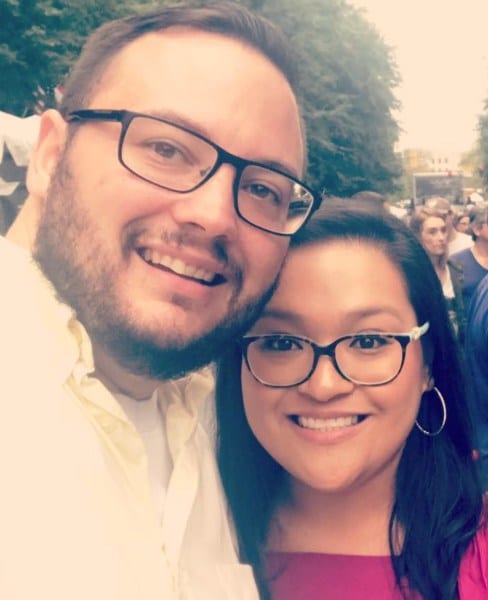 Why did you get into travel nursing?
Lesley: We initially got into travel nursing to pay for our wedding, but we fell in love with traveling so much that we decided to continue. We have met so many wonderful people along the way and have experienced so much together in a short amount of time. It’s definitely made us a stronger couple with the challenges of traveling together!
Chris: For me it has been a goal, and when my life finally allowed me to go, I seized the opportunity. I had just asked Lesley to marry me right before we started our first contract. We made it our goal to travel nurse, so we could pay for our wedding. Now, that we’re married, we continue to travel nurse because we love it.

Chris: A pro is you always have someone to travel with not only to explore, but someone who can takeover driving cross country. Also, when you start at a new hospital and you’re on two different floors, you get to meet twice as many people — you make friends so much faster.
If you work on the same unit, then you never get any time apart, which can be a con. This happened to us for a couple of contracts and you begin to really appreciate your alone time.
Lesley: Pros of traveling together — he does all the heavy lifting! We travel with a travel trailer, so he handles the majority of that. I also have someone I trust if I have nursing-related questions. Chris is a very intelligent nurse is is well-respected at all of the facilities we’ve traveled to (I’m so proud to call him my husband!) One con of traveling together is living in our small travel trailer, especially when we both were on night shift and working opposite nights.
Chris: Take it slow and do your research. Join FaceBook groups and read discussions, ask questions, and soak up as much knowledge as you can. Also, no matter how many years experience you have, you are the new nurse every assignment.
Discuss as a couple what your goals are as travel nurses and stick to them — Is it to pay off debt? See the country? Or, to to decide where to settle down?
Communication is key! It’ll cut down on the stresses that packing, moving, and resettling every 13 weeks can put on a relationship.
Chris and Lesley
Lesley: Be open minded and flexible. Your wish list of places and/or facilities may not work out, so explore all of your options. Find a recruiter that the both of you trust and have a good relationship with. Also, one of you my have an assignment while the other doesn’t — always have a backup plan and money saved up!

Chris: Definitely, Alaska, and either Guam or Hawaii. I want Barrow, Alaska above the Arctic Circle, but I may have to compromise for something more mild like Anchorage.
Lesley: Alaska has always been on our bucket list travel destination! Neither of us have ever been, and we’ve talked about how great of an experience it would be.
Explore the country while doing what you love! Click here to connect with a recruiter.
 Meet the Couple: Krystal & Nick
Krystal and Nick have been nurses for about 2.5 years and been dating for 1.5 years. They met on Instagram through the unintentional matchmaking skills of Angelina from @travelnursinginsider after Nick happened upon a photo of Krystal and DM’d her. That DM turned into phone calls, then FaceTime dates, then to a handful of flights out to Vegas, where Krystal was living. Soon Nick was living there too.
Krystal and Nick enjoy everything from hiking and camping to binge-watching their favorite show (currently, This Is Us, though Nick won’t admit it). Avid readers and self-proclaimed wine connoisseurs, they also like to cook and work out (Nick runs. Krystal runs to Target.)
Discover your dream travel assignment here.
Krystal: Travel nursing sounded exciting and challenging (it 100 percent is!) and I knew I’d regret it if I didn’t try. But, it wasn’t until I met Nick and we talked about doing it together that I was ready to take the leap.
Nick: I like challenges and to test my ability to adapt to the way the new unit works, new charting systems, new policies, etc. Being a travel nurse has boosted my nursing self-confidence and is great experience. I also love to travel and meet new people.

Krystal: Having the opportunity to explore a new place with your best friend is a big pro, but it can be tough if your schedules don’t line up. Currently, I’m on night shift and Nick is on day shift. Traveling together has made us stronger — it hasn’t always been easy, but we’ve managed to support one another and make it work.
Nick: It’s a great testament to your relationship if you can work through the stresses of frequently moving and traveling together. It’s also pretty great to get to share the experience of a new city with someone you love. There would be a lot of FOMO if one of us was traveling without the other! You have to be more flexible to find contracts that accommodate both of you, though — we’ve had to compromise for two contracts that are at the same hospital with same dates.
Krystal: Have patience! It took us awhile to find contracts that worked for both of us, since we’re in different specialities. Be willing to compromise a little too — I wasn’t thrilled that Nick and I would be on opposite shifts, but ultimately, we knew it wouldn’t stop us from enjoying our free time together.
Have patience with each other too. You’re going to learn a lot about each other — somethings you’ll love and others not so much. Be able to acknowledge when you need some space or “me” time.
Pro Tip: Find a travel nurse recruiter who has patience to give you the attention you need as a couple.
Nick and Krystal
Also, hospitals can be fluid with position start dates. We found that submitting applications for contracts and then telling the interviewing managers about our unique situation has encouraged some flexibility on the hospital’s part. When I interviewed for my current unit, I told the manager that I was traveling with my fiancée and we were a package deal. He worked with HR and they placed her in a unit quickly!
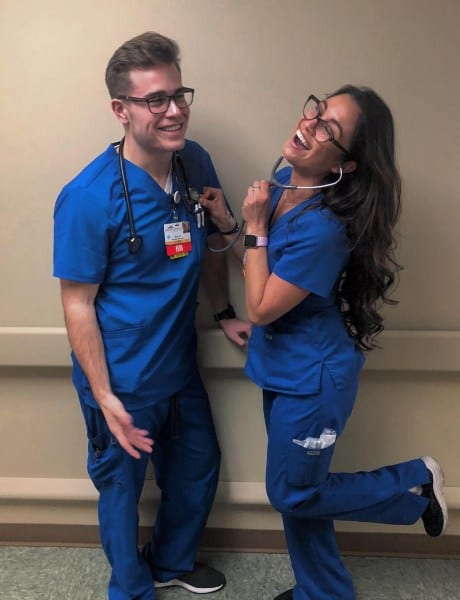
Nick: Seattle, of course! It’s been our only assignment, but prior to coming we heard from our travel nurse friends how great we’d be treated here. The hospitals are incredible, the mountains are gorgeous, and the food delicious.
Krystal: Yes! The mountains are incredibly beautiful and it’s so green. After living in Vegas for so long, I’ve also learned to appreciate how much water there is around here.
Krystal: After this assignment, we’re going to pause on travel nursing for a bit. But, when we pick it up again, we’d love to go to California, Alaska, and maybe out of the country!
Nick: I’m starting graduate school in May to study to be an Acute Care Nurse Practitioner, which is forcing us to pause on traveling. If we start back up, then definitely California, Alaska, and potentially Hawaii.
Explore the country while doing what you love! Click here to connect with a recruiter.
Meet the couple: Chase & Lindsay
Best friends who are also married, Chase and Lindsay are currently RV-living full-time with their cat, Moka. They met at WVU during their freshman year of nursing school, and have been together for over five years, married for over three.
Their primary interest is traveling, but their other hobbies include photography, drones/videography, hiking, snorkeling, and woodworking. Their woodworking hobby is a side business too — funding their travel adventures and helping pay off student loan debt.
Guilty pleasures: local food and craft breweries.
Discover your dream travel assignment here.

Lindsay: We both worked staff for four years and were always planning trips every month to go explore somewhere new. The wanderlust was real. We decided that travel nursing was the perfect balance of nursing and traveling for us. We started getting serious about a year ago, did the research, bought the RV, and started the journey. You get paid to travel, what more could you possibly want!?
Chase: We also talked to other nurses at our home hospital who had done travel nursing and were able to ask a ton of questions. I have to give credit to Lindsay though — she did hours of research online and got us set up with recruiters. Before we knew it, we were actually planning our first assignment. Now, here we are six months later totally enjoying this adventure together.
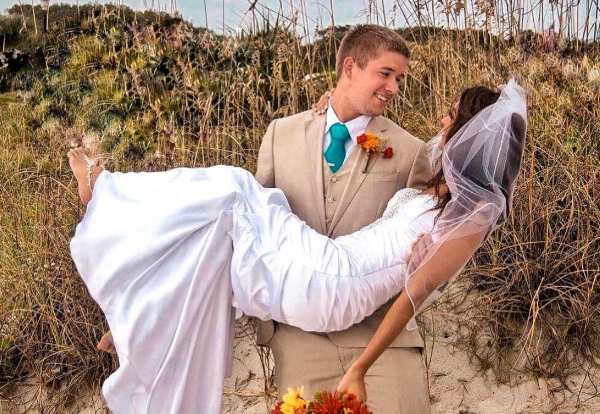 Chase: The biggest pro of traveling together is that we get to experience everything together and be there to support each other. We both admit that doing this alone would be significantly more difficult. One con is that some facilities are hesitant to hire couples, but if we ever get turned down for a job, we know it wasn’t meant to be and keep looking.
Lindsay: I would say the pros totally outweigh the cons. I love having Chase to adventure with and to vent to after a long, demanding shift. It beats traveling alone any day! To us, being together is a MAJOR plus, but to some it may be tough. When travel nursing together, you have the potential to be around each other 24/7, so alone time and personal space may be a con for some.
Also, we have to find two job openings in the same unit for the same shift since we both specialize in CVICU nursing. That can really narrow down the job search for us and may be considered a con.
Chase: Be professional. Often people don’t even know we’re married or traveling together. Their reactions are priceless when they find out.
Lindsay: What Chase said! We had a physical therapist at our current assignment try to set us up before she found out we were married.
Another piece of advice is to try and work the same shift (not necessarily the same schedule, but the same shift). It would be too hard for us if one worked days and the other nights.
Chase: We’ve completed one contract in Orlando and are now on our extension. We’ve been able to explore both Florida coasts and a few natural springs. The natural springs here are something to experience!
Lindsay: We’re currently in Orlando, Florida and loving it! The assignment is busy and challenging and we love the location. Orlando is central, you can take day trips almost anywhere in the state. There is a lot to do and explore.
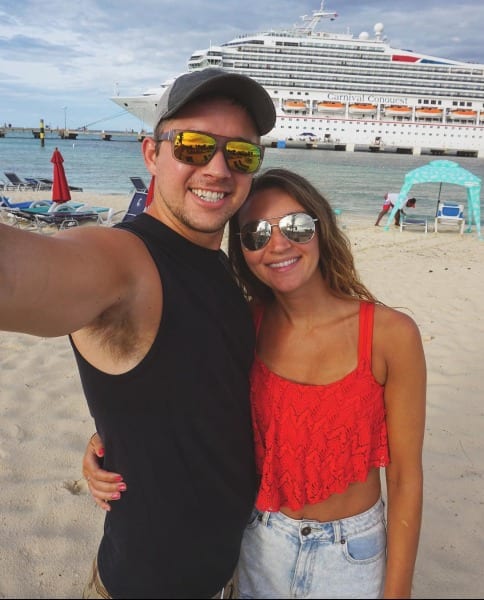
Chase: Our hope is to head west and explore. Some states in mind are Texas, New Mexico, Arizona, Utah, Washington, and Oregon. Then, we hope to travel to Alaska and Hawaii.
Lindsay: This is such a hard question, because I want to see everything. My top destinations are Alaska, Hawaii, the PNW, Arizona, and possibly Guam or St. Thomas in no particular order.
Explore the country while doing what you love! Click here to connect with a recruiter.
Nursing is a profession that can be practiced in all parts of the United States. However, there are notable differences in the way you may perform some of the tasks depending on your location. Before choosing where you’d like to start or continue your career, it’s beneficial to take a look at some of the differences as well as the similarities.
After surveying nurses from four US regions about various topics about their careers, it is clear that nursing is a job that is exhausting and challenging, but ultimately rewarding and amazingly satisfying.
Learn about rewarding career opportunities as a travel nurse.
The nurses who shared their thoughts with us are:
Ashley Floral, RN – Omaha, NE
As the charge RN in the Newborn Intensive Care Unit (NICU) at Children’s Hospital and Medical Center, Ashley loves being a nurse and getting close to all the babies and their parents.
Dr. Kristine Todd, NP – Grand Rapids, MI
Director of Professional Practice and Development in Nursing Administration at Mercy Health St Mary’s, Dr. Todd speaks at numerous national conferences and sees patients as a Nurse Practitioner a few days a month.
Jason Sawa, RN – Dallas, TX
Jason is an RN and inpatient care coordinator at Texas Scottish Rite Hospital for Children in Dallas, TX.
Patricia Falgoust, RN – Harrisburg, PA
Patricia currently works as a nurse manager of labor & delivery at PinnacleHealth System.
Every department has its ups and downs; its good and bad situations. Here are some of the topics these nurses were asked about in their respective hospitals and areas of the country. Listening to them gives us a feel for what goes on, what is changing and what needs changing.
All of the nurses believed that their profession in their hospital and area is highly respected. Sawa elaborates by saying, “as a pediatric orthopedic hospital that specializes in the treatment of scoliosis, I would say our doctors see us as the ‘spine’ of the hospital. We are the eyes and ears of the doctors, and the voices of the patients.”
Falgoust believes that the health system she works in fosters and supports inter-professional collaboration, and it shows in the quality measures and outcomes and overall patient satisfaction.
Live in your dream city while doing what you love.
Each area of the country is dealing with different levels of becoming fully electronic when it comes to patient information. Foral says her hospital is all computerized with computers in each room along with barcode scanners for medication administration. All nurses have iPhones for communication via the Volt app.
“We are able to text as well as call our co-workers for any of our needs. Our workflow has improved since going live on EPIC. It is frustrating when technology fails,” she states.
Todd explains that health records are all electronic at her Grand Rapids hospital, and they use smartphones for use with the Doc Halo secure messaging system between nurses and doctors.
 Falgoust’s hospital is in the process of changing to an electronic medical record and charting system, which should happen in October. “Having multiple systems that don’t communicate can make nurses less efficient,” she says.
Sawa’s hospital is also going through a build phase of a new electronic health record system which is expected to go live in October, too.
Speak to a staffing agent today.
Sawa believes that his hospital is a special place that gives children back their childhoods. “Our nursing staff is outgoing and friendly, and we set the bar high for the expectations of ourselves and our fellow nurses,” he says.
Whether it’s in the Midwest or not, Foral feels that anyone working in an intensive care unit, probably is going to be a Type A personality.
“We have to be. There is very little room for error when you are taking care of a 900 gram baby. We are meticulous across the continuum of care from our assessments to the perfect blanket lined on the baby’s bed,” she explains.
In Falgoust’s nursing staff, she believes all types fit well. Todd narrows it down to the kind, compassionate, respectful, knowledgeable and collaborative personalities work out better in her unit.
Discover new travel assignments in your specialty here.
Mercy Health Saint Mary’s in Grand Rapids serves a diverse patient clientele with specialties of oncology, neuroscience, cardiovascular, orthopedic, senior care and psychology-medical.
PinnacleHealth Systems offers opportunities for all nursing specialties, Falgoust says.
The Children’s Hospital in Omaha is the only level IV NICU in the region. “Patients from Nebraska, Iowa, Kansas and South Dakota come here for the highest level of care,” Foral states. “Omaha is so fortunate to have a pediatric hospital.”
Travel nurses are in high demand. See how to start your adventure today.
“I am satisfied with my pay to a certain degree. We need the best of the best nurses here every day to take care of our patients,” Foral says. “I believe the hospital needs to be more appealing to entice experienced nurses looking for a change in their career. Children’s is offering a very generous incentive program when our census is high, and staffing is short.” Todd and Falgoust say nursing pay in their hospitals is very competitive with area hospitals, and Todd adds that her hospital offers an excellent advancement system for nurses.

Whatever their complaints or praises, these nurses love what they do. Foral sums up the general feeling of our four nurses — “I am honored to be a nurse and am forever grateful I chose this profession. I feel honored to be a nurse. I am proud to be a nurse.”
Discover new travel assignments in your specialty here.
Travelnursing.org interviewed travel nurse Kyle Leffel, RN about his experience on his first travel assignment.
New travel nursing jobs available here.
That’s a great question! I went into my first contract with big open arms. I wanted to experience everything travel nursing had to offer, but if I had to pick something I would say that I wish we would have stayed longer.
My wife and I were so eager to get out and travel to our next assignment, we were unable to stay and experience more of the state where we were staying.
I live in Indiana and my first contract was in Washington State. I don’t know when the next time I will be able to hike in all of those national parks again.
While I look at those beautiful pictures we took hiking along Mount Rainier, I often find myself wishing I would have accepted their offer to extend my contract for another three months.
No not really. I did look up the hospital and the geographical location of it in relation to our apartment, but other than that I relied totally on what my recruiter relayed to me.
I do remember asking about the unit staff and their current dynamics during my interview with the unit manager, but I was more focused on the 30 + hour drive I had to do to get to our next stop.
Discover new travel assignments in your specialty here.
My wife and I worked together. We knew that this adventure we were embarking on would require us to set a budget, and work together on it. So we set a monthly budget and did our best to stick to it. We knew how much to pay for bills and general expenses, but then we wanted to budget some splurge money so we could see all the sights and activities each location offered.
Travel nursing is like going on a giant long vacation. If you don’t budget your money, you will end up spending it all on eating out and on buying things. Trust me when I say this…BUDGET YOUR MONEY! Otherwise all that money you were excited about earning, just flew right out the window.
I knew a lot. The company I was traveling with did an excellent job of providing me education on the location. They paid for all the utilities and everything in the housing unit was fully furnished. They emailed me maps and phone numbers for our temporary home.
They were very detailed with providing excellent travel nurse housing, and they even gave us information of all the local attractions surrounding the apartment.
Explore the country while getting paid! Find assignments in your dream city here.
For my first assignment my company recommended that I let them place me because they didn’t want me to have to worry about setting everything up for my first time. They wanted my focus to be on my transportation to get there, and to enjoy the overall experience.
I am glad I listened to them because they were absolutely right. I had plenty of other things to worry about, and that was the last thing I wanted to have to set up.
Actually, its funny you ask that because there was one hiccup — I guess that’s what you would call it.
My first contract was just a little south of Seattle, Washington. We arrived there late summer so after our long drive and from unpacking our car, we were a little hot and stuffy so we decided to turn on the air conditioner to our new apartment, in order to cool down. Well guess what? It didn’t have one. We searched our whole apartment trying to find the stupid thermostat!
Apparently, this is a common thing for the locals of Washington State.
They don’t usually need AC, they just open the windows and let the cool mountain breeze in. I grew up in a typical Midwest household with air conditioners. We don’t leave our windows open, unless you plan on getting robbed. So after our little culture shock we actually learned to embrace this, and really learned to enjoy it.
New travel nursing jobs available here.
Absolutely! The unit I was on actually used a lot of travel nurses before. So they were very accustomed to travelers, and accommodating to me.
I was surprised that even the physicians were used to having us. They would always go out of their way to get to know us, and welcome the opportunity to teach me new things.
What surprised me the most was how easy it was to travel as a nurse. I was nervous and a little scared that I wouldn’t like it, but to my surprise, I actually really enjoyed my time traveling.
After a few weeks of getting my feet wet, I wished I would have started earlier. It really was everything that I was hoping it was going to be.
That I would love it and I would cherish those moments with my wife forever.
To learn more about Kyle and his decision to become a travel nurse, check out A Journey into Travel Nursing.
For more on this series:
Interview With A Travel Nurse: Preparing for a New Facility
Interview With A Travel Nurse: How to Recover From Failing the NCLEX
Interview With A Travel Nurse: How To Prepare To Be A Rock Star Travel Nurse – Before You Are One
Interview With A Travel Nurse: Sure-fire Signs You’re Working With The Wrong Staffing Agency
Interview With A Travel Nurse: Preparing For Travel Nursing Even Before Nursing School