Toggle navigation

SUCCESS!
We look forward to helping you advance your career as a travel nurse!

This week’s travel nurse COVID-19 front lines story comes courtesy of Natasha, RN, BSN, ACLS, a 31-year-old critical care nurse from Philadelphia who is currently working in an assignment in Bronxville, New York.
I care, I want to help—this is what I was meant to do. But this level of staffing and lack of PPE just puts what little staff we do have at high risk.
Natasha has been a travel nurse since June 2019 and tells TravelNursing.org that she was already on assignment when the pandemic broke out.
Interested in travel nursing in areas impacted by COVID-19? Start here.
What is the situation like at your current facility?
“[In] the weeks leading up to the full-blown epidemic, rules and policies were changing every few days. At first, we were being reprimanded for using our N95s in the ICUs by administration because ‘we should only be using them when you are planning to suction your patient’—which is something I anticipate every time I go into my patient’s room as an ICU nurse.
[Now,] they are reprimanding us for spending more than 20 minutes in patients’ rooms, but I am being put into a room with 4 critically ill patients that I am being asked to keep alive so that is an impossible task. We are currently being given one N95 that we are expected to keep for the week. Along with the N95, I am given one face shield and hair net that I am expected to use for the shift. The charge nurses are trying to look out for us and doing their best and if there is an extra around, they give it to us, but it is like we are dealing drugs.
Due to the aerosolization, we are no longer bagging patients during codes. Last week I did CPR on 3 patients. This has also changed. We are now only pushing medications and shocking shockable rhythms during codes for these patients with minimal staff in the room to limit exposure.”
Do you feel like you have adequate PPE?
“No, I do not feel like I have enough PPE and we do not have enough staff to ensure minimal exposure. Mind you, during the shift I just mentioned, I was pulled to one of our makeshift ICUs that were created during the rise of COVID, so my fellow nurses in my home unit were taking care of 8-9 ventilated patients. We are very at risk.
Luckily, I have a can of Lysol that I spray my N95 with at the end of each shift, along with the rest of my uniform and shoes. A lot of staff has been exposed, which may contribute to the lack of staffing, but we were already short-staffed to begin with. Perhaps if administrators would have allowed us to protect ourselves from the beginning, this wouldn’t have happened.”
Can you describe your typical shift?
I used to come in for a 12-hour shift, but due to the workload, I typically end up doing 15 or 16 hours. If I am on my unit, the first thing I do is don my face shield and N95. I come into the hospital with a hair net. I try to get a report from the night shift staff and am typically interrupted by the need to refill 3-7 IV bags that are keeping my 8 patients alive.
After I have gotten a breakdown of my patients’ drips and vent settings, I am scrambling from room to room without a break for many hours to give medications, draw labs, etc. There is no time for phone calls, there is no time for “fluff” — it’s just “do everything you can to keep them alive.” I don’t matter anymore, I am a robot with some skills and my function is to save whoever I can.
Typically, I will have several patients desaturating at once and I am forced to assess which room I go into first. The 37-year-old is 88%, the 70-year-old is 84%, and the 50-year-old is 87%… so I go into the 37-year-old’s first, try to get his sats up, then the 50-year-old, then the 70-year-old. That’s how I’m being forced to function right now.
I was in a room the other day for 11 hours with 4 intubated patients who were very ill and likely had very high viral loads. If I was not in the room, the patients would have died due to me not suctioning their airways and not keeping their vasopressors adequately titrated.”
What has been the hardest part of working as a travel nurse during this pandemic?
“I am a very hard worker but being placed into a situation where you are told you have to care for 4-9 vented patients who are all dying is physically and mentally taxing. I have so much exposure, it’s not even funny. It’s like people are pretending not to notice and I am just the sacrificial lamb.
I care, I want to help — this is what I was meant to do. But this level of staffing and lack of PPE just puts what little staff we do have at high risk. Honestly, I’m sure I will get the virus, I just hope that my immune system is strong enough to fight it off. Emotionally, it’s challenging. I am seeing people who are all different ages with no and few co-morbidities become very ill, go into ARDS, and then kidney failure from this, and I wonder if that’s God’s plan for me.”
What has surprised you the most about working as a nurse during this time in history?
“I think one thing this has shown is what leaders we are as nurses. All the titles and egos from all different positions disappear when you are trying to keep people alive. We all have to function as a team.
I found myself working with a group of patients the other day and was basically directing an attending cardiothoracic surgeon on the plan for my group of patients. He listened to me. In another situation, I probably wouldn’t have been as forward but the situation has pulled the leader out of me because that’s how I have to adapt to keep my patients alive.”
What kind of fears do you have currently about working as a travel nurse during a pandemic?
“I think I speak for all nurses, not just travelers, when I say that I am afraid of contracting the virus and falling very ill.
Specifically, as a traveler, I am worried that if I do fall ill, I won’t be able to see my family. I haven’t seen them since Christmas and I don’t know when I will see them again.”
How you are taking care of yourself?
“I am trying to be kind and forgiving to myself. I am trying to remember that these are not normal circumstances—this is a pandemic. I am one body in this ocean trying to keep everyone alive, but at the end of the day, it’s not completely within my control.
I am actually really grateful in this time that we have the technology to Facetime friends and family, especially others in the field. It allows me to feel connected even when we are miles apart from one another. I think having the ability to speak with other nurses and friends in healthcare during this time has been really helpful emotionally. I’m sharing a lot more on social media then I typically would because I honestly need support right now. It’s helping.”
What advice would you give any travel nurse thinking about taking a COVID assignment right now?
“Please allow yourself to get adequate sleep and take care of your bodily necessities like hydration and nutrition first and foremost.
Be prepared mentally to work in really challenging conditions and know that everyone your working with is stretched extremely thin. Please come prepared to work — there is a lot of money being offered, but the truth is no amount of money is going to make what you’re walking into acceptable.
At the end of the day, remember that we are trying to save the lives of other humans, but we are only humans and that we are not in control of the universe’s greater plan.”
Interested in travel nursing? Speak with a recruiter here.
Shannon, 35, BSN RN CCRN, is a travel ICU nurse and is currently on assignment in a COVID-19 affected area. She shared her story about working on the frontlines with TravelNursing.org.
I’ve gone from concern to disbelief to total panic and back again many times.
She has documented many of her travel nursing adventures on her Instagram account, @headstandsonholiday, and has continued to speak about the conditions that travel nurses and nurses are facing in working through COVID-19.
Interested in travel nursing in areas impacted by COVID-19? Start here.
Here, Shannon tells us what she is currently experiencing as a travel ICU nurse on the frontlines:
Did you volunteer to sign up for a COVID-19 assignment?
Yes, my contract was ending as COVID was ramping up here in the U.S. I was supposed to go on a trip to South East Asia but obviously, that’s put on hold indefinitely. I explored some crisis contracts with my recruiter and even submitted to one place that was paying higher than I’m making.
I ended up just submitting for an extension at my current assignment after talking to my mom. She asked me not to put myself into immediate danger if I didn’t have to. After signing my extension contract, I got a call from a recruiter about a week later and he told me that I’d be getting crisis pay for my entire extension. I was stoked so I re-signed at the higher rate. And here I am. We haven’t seen the surge of COVID patients lots of bigger cities have seen yet and only started even having positive cases this week.
What is the PPE situation at your facility?
The policy about PPE has changed dramatically over the last several weeks. First, they asked us to be “good stewards” about our PPE (basically don’t wear a mask unless it’s indicated). Then they said we can’t wear our own masks from home.
Since March 12, I’ve been wearing a simple mask every day. For a while, I was the only one. These days, masks aren’t mandatory for all staff, but managers and charge nurses aren’t telling anyone to take them off. With regards to COVID patients, they are asking us to use “enhanced droplet precautions” so basically they followed the CDC guidelines of “droplet unless performing an aerosolized procedure” which is not good enough if you ask me.
All evidence on the internet points to this virus being airborne for hours after aerosolization. In addition, many patients aren’t getting tested/aren’t showing symptoms. So, once again, this is an example of healthcare being reactive instead of proactive. Yes, we do have PPE, but I’m uninterested in any policy that doesn’t adequately protect me so I’ve been going into my COVID and COVID PUI rooms with a PAPR or an N95. I wear a simple mask at all other times.
We’re not really rationing PPE yet but we’ve been asked to clean and reuse our PAPR shields. Additionally, I’ve worked as a nurse in 3 states and have friends in healthcare all over the U.S.
A classmate from nursing school literally begged for people to send her PPE on Facebook. She works in the Bronx. A friend from high school had donated a box of n95 masks to me, so I turned around and sent 10 to the girl in the Bronx the next day.
How are you feeling working as a nurse through this pandemic?
I’ve gone from concern to disbelief to total panic and back again many times. There have been lots of tears and panic attacks and feelings of helplessness. It started in late January for me. My worst week was in mid-March when it just felt like the walls were closing in and no one I knew in the US was prepared for it.
Now, several weeks in, I’ve adjusted to the new normal. And I know I can do this job and do it well and take care of these patients as long as I have the right PPE. But I still get anxiety the night before my Monday of my work stretch. It feels like the same sort of anxiety I used to have as a new grad and a new ICU nurse many years ago. It’s a bad feeling. What will I encounter today?
What would you advise travel nurses considering working in a COVID area?
My biggest encouragement to nurses everywhere is to take care of yourself first. Health over wealth.
To travelers: don’t settle for any agency or facility that doesn’t prioritize your health and wellbeing. Our work is essential, yes, but we can’t do our jobs without the proper tools. And wear a mask no matter what anyone tells you.
Interested in travel nursing? Speak with a recruiter here.
The New York area has been the most affected by COVID-19 in the United States. Already crippled under the weight of patients who need care from COVID-19, the governor sounded the alarm on March 24th that the peak infection rate is still about two weeks away. That means that as bad as NY is, it’s going to get even worse.
And that means that the need for travel nurses in the New York area is at a critical level.
Start your travel nursing career today!
As of Wednesday, NYC infection rates had surpassed 15,000 and officials admitted that efforts to contain the virus simply had come too late. Right now, infection rates are doubling every three days, a number that places the need for hospital beds at double what the state actually has available.
“We’re not slowing it — and it is accelerating on its own,” NY Governor Andrew Cuomo said in a press conference. “We’re not looking at a freight train. We’re looking at a bullet train because the numbers are going up that quickly.”
There has also been a lot of fear, even among travel nurses normally willing to work. According to the New York Times, unfortunately, some travel nurses have been reluctant to travel to hard-hit COVID-19 affected areas, like New York. One nursing staffing agency director NYT that an “unprecedented number” of travel nurses that are regulars with their agency are backing out of offered assignments in New York.
With the rise in the number of people who will need care as a result of the virus, there is also a dire need for nurses to actually perform that care. Many nurses already working in the NY area are exhausted, burned out, or may be under quarantine themselves after initial exposure — especially because in the early days of the infection, there has not been enough personal protective equipment (PPE) to prevent those nurses from getting infected.
The good news is, however, that private companies are stepping up to the plate to ensure hard-hit areas are getting more PPE. For instance, 3M has sent half a million N95 masks to Seattle and New York.
Virtually any nursing opportunity you are interested in is available in NY right now — staffing agencies are advertising any shift, any hour, along with expeditated clearing and licensing processing. One nurse recruiter tells TravelNursing.org that in the New York area, there is a high need for ER and critical care nurses especially in the Manhattan, Brooklyn, and New York City areas.
It may sound somewhat crass to say it, but at a time like this, if you’re willing to work in NY, you may get to get to choose exactly what kind of shift you are willing to work. Want to only work days? Only have time for 4-hour shifts? Prefer to work strictly on an on-call basis? Chances are, if you’re willing to work, the hospitals in the area will take any help they can get.
Although travel nursing positions in COVID-19 affected areas have been averaging around the $3-4K per week levels, as the demand goes even higher, pay offers are also starting to increase drastically too.
For instance, the public Facebook group New York Nurse Opportunities lists several travel RN posts in the New York area to connect nurses directly with travel nursing opportunities. One job in the group from Atlas Med Staff, a NY-based staffing agency lists an ER opening in Forest Hills, New York at a whopping $5,582 a week for a 13-week assignment (the pay includes a $70/hourly taxable wage, along with $1,673 non-taxable stipends.)
“Many agencies are posting anywhere from $3,000 to $5,200 per week for nurses,” a nurse recruiter, speaking anonymously, says. “Those include the weekly allowances travelers receive.”
The increased demand for travel nurses also means almost every New York hospital is also asking for LPNs to take on temporary positions, so if you’re an LPN who has had trouble finding travel nurse opportunities in the past, that won’t be the case any longer.
Discover available travel nursing assignments!
The same nurse recruiter was able to clear up a few other FAQs you may have about working as a travel nurse:
Will your agency provide you with PPE?
“Typically, agencies do not provide PPE,” he says.
What happens if you have to get quarantined?
“Agencies are providing pay if a nurse is forced into quarantine — this will include the pay, weekly allowances, and/or if they had their housing set up with their contract.”
Will you get help with housing?
Yes, and he notes many hotels are offering discounts for healthcare workers at this time.
What are the most in-demand RN positions?
“The ICU and ER are the most critical needs,” he says. “But hospitals and communities are needing screeners and help with testing, which may rise as tests begin to flood the markets.”
How fast can you really get an out-of-state license?
“[There is a] lot of misconception on this one” he explains. Ultimately, it’s up to the hospital if they will accept an out-of-state license. “Usually getting a license can take a few weeks,” he adds. “Only one hospital I am aware of is currently taking out-of-state licensure.”
Is this really a good time to take on a travel RN job?
Bottom line, yes. “People need help, outside of all the contract piece, the pay, the red tape,” he points out. “People need help, other nurses need support… It is a great time to step up for a community, city, or country.”
Start your travel nursing career today!
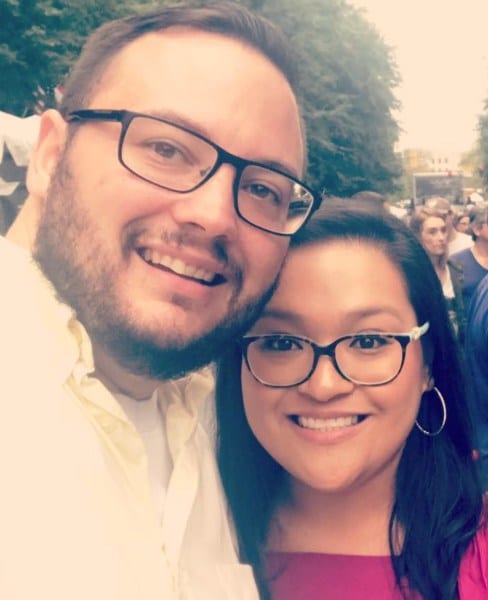
Meet the Couple: Chris + Lesley
Chris and Lesley have been travel nurses for 2.5 years and together for the last five years (married for two!). They met on a dating site, though they like to tell people they met on Craigslist’s casual encounters. Chris and Lesley like to travel and explore nature, learn about different cultures, and find the best hole-in-the-wall eateries and craft beers (Chris is a huge fan).
Lesley is currently between assignments (she’s at a private-duty job on the side) taking a break to do some international travel while Chris is working for the US Embassy in Pakistan.
Discover your dream travel assignment here.
 Why did you get into travel nursing?
Lesley: We initially got into travel nursing to pay for our wedding, but we fell in love with traveling so much that we decided to continue. We have met so many wonderful people along the way and have experienced so much together in a short amount of time. It’s definitely made us a stronger couple with the challenges of traveling together!
Chris: For me it has been a goal, and when my life finally allowed me to go, I seized the opportunity. I had just asked Lesley to marry me right before we started our first contract. We made it our goal to travel nurse, so we could pay for our wedding. Now, that we’re married, we continue to travel nurse because we love it.

Chris: A pro is you always have someone to travel with not only to explore, but someone who can takeover driving cross country. Also, when you start at a new hospital and you’re on two different floors, you get to meet twice as many people — you make friends so much faster.
If you work on the same unit, then you never get any time apart, which can be a con. This happened to us for a couple of contracts and you begin to really appreciate your alone time.
Lesley: Pros of traveling together — he does all the heavy lifting! We travel with a travel trailer, so he handles the majority of that. I also have someone I trust if I have nursing-related questions. Chris is a very intelligent nurse is is well-respected at all of the facilities we’ve traveled to (I’m so proud to call him my husband!) One con of traveling together is living in our small travel trailer, especially when we both were on night shift and working opposite nights.
Chris: Take it slow and do your research. Join FaceBook groups and read discussions, ask questions, and soak up as much knowledge as you can. Also, no matter how many years experience you have, you are the new nurse every assignment.
Discuss as a couple what your goals are as travel nurses and stick to them — Is it to pay off debt? See the country? Or, to to decide where to settle down?
Communication is key! It’ll cut down on the stresses that packing, moving, and resettling every 13 weeks can put on a relationship.
Chris and Lesley
Lesley: Be open minded and flexible. Your wish list of places and/or facilities may not work out, so explore all of your options. Find a recruiter that the both of you trust and have a good relationship with. Also, one of you my have an assignment while the other doesn’t — always have a backup plan and money saved up!

Chris: Definitely, Alaska, and either Guam or Hawaii. I want Barrow, Alaska above the Arctic Circle, but I may have to compromise for something more mild like Anchorage.
Lesley: Alaska has always been on our bucket list travel destination! Neither of us have ever been, and we’ve talked about how great of an experience it would be.
Explore the country while doing what you love! Click here to connect with a recruiter.
 Meet the Couple: Krystal & Nick
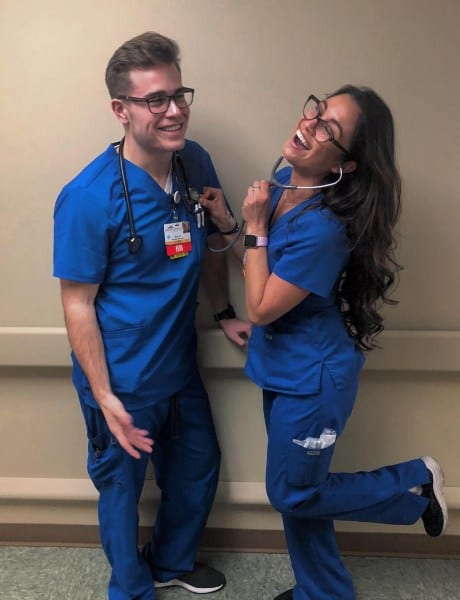
Krystal and Nick have been nurses for about 2.5 years and been dating for 1.5 years. They met on Instagram through the unintentional matchmaking skills of Angelina from @travelnursinginsider after Nick happened upon a photo of Krystal and DM’d her. That DM turned into phone calls, then FaceTime dates, then to a handful of flights out to Vegas, where Krystal was living. Soon Nick was living there too.
Krystal and Nick enjoy everything from hiking and camping to binge-watching their favorite show (currently, This Is Us, though Nick won’t admit it). Avid readers and self-proclaimed wine connoisseurs, they also like to cook and work out (Nick runs. Krystal runs to Target.)
Discover your dream travel assignment here.
Krystal: Travel nursing sounded exciting and challenging (it 100 percent is!) and I knew I’d regret it if I didn’t try. But, it wasn’t until I met Nick and we talked about doing it together that I was ready to take the leap.
Nick: I like challenges and to test my ability to adapt to the way the new unit works, new charting systems, new policies, etc. Being a travel nurse has boosted my nursing self-confidence and is great experience. I also love to travel and meet new people.

Krystal: Having the opportunity to explore a new place with your best friend is a big pro, but it can be tough if your schedules don’t line up. Currently, I’m on night shift and Nick is on day shift. Traveling together has made us stronger — it hasn’t always been easy, but we’ve managed to support one another and make it work.
Nick: It’s a great testament to your relationship if you can work through the stresses of frequently moving and traveling together. It’s also pretty great to get to share the experience of a new city with someone you love. There would be a lot of FOMO if one of us was traveling without the other! You have to be more flexible to find contracts that accommodate both of you, though — we’ve had to compromise for two contracts that are at the same hospital with same dates.
Krystal: Have patience! It took us awhile to find contracts that worked for both of us, since we’re in different specialities. Be willing to compromise a little too — I wasn’t thrilled that Nick and I would be on opposite shifts, but ultimately, we knew it wouldn’t stop us from enjoying our free time together.
Have patience with each other too. You’re going to learn a lot about each other — somethings you’ll love and others not so much. Be able to acknowledge when you need some space or “me” time.
Pro Tip: Find a travel nurse recruiter who has patience to give you the attention you need as a couple.
Nick and Krystal
Also, hospitals can be fluid with position start dates. We found that submitting applications for contracts and then telling the interviewing managers about our unique situation has encouraged some flexibility on the hospital’s part. When I interviewed for my current unit, I told the manager that I was traveling with my fiancée and we were a package deal. He worked with HR and they placed her in a unit quickly!
Nick: Seattle, of course! It’s been our only assignment, but prior to coming we heard from our travel nurse friends how great we’d be treated here. The hospitals are incredible, the mountains are gorgeous, and the food delicious.
Krystal: Yes! The mountains are incredibly beautiful and it’s so green. After living in Vegas for so long, I’ve also learned to appreciate how much water there is around here.
Krystal: After this assignment, we’re going to pause on travel nursing for a bit. But, when we pick it up again, we’d love to go to California, Alaska, and maybe out of the country!
Nick: I’m starting graduate school in May to study to be an Acute Care Nurse Practitioner, which is forcing us to pause on traveling. If we start back up, then definitely California, Alaska, and potentially Hawaii.
Explore the country while doing what you love! Click here to connect with a recruiter.
Meet the couple: Chase & Lindsay
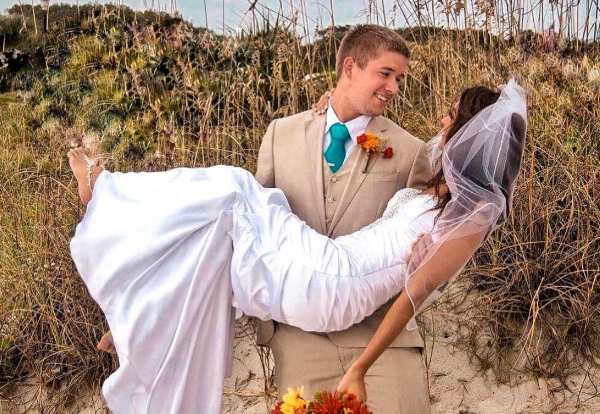
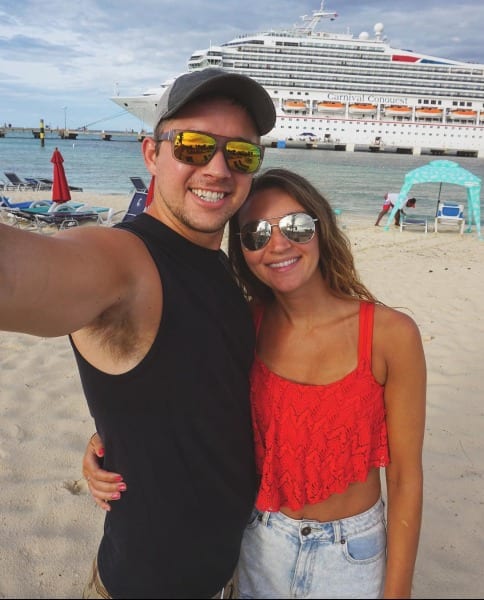
Best friends who are also married, Chase and Lindsay are currently RV-living full-time with their cat, Moka. They met at WVU during their freshman year of nursing school, and have been together for over five years, married for over three.
Their primary interest is traveling, but their other hobbies include photography, drones/videography, hiking, snorkeling, and woodworking. Their woodworking hobby is a side business too — funding their travel adventures and helping pay off student loan debt.
Guilty pleasures: local food and craft breweries.
Discover your dream travel assignment here.

Lindsay: We both worked staff for four years and were always planning trips every month to go explore somewhere new. The wanderlust was real. We decided that travel nursing was the perfect balance of nursing and traveling for us. We started getting serious about a year ago, did the research, bought the RV, and started the journey. You get paid to travel, what more could you possibly want!?
Chase: We also talked to other nurses at our home hospital who had done travel nursing and were able to ask a ton of questions. I have to give credit to Lindsay though — she did hours of research online and got us set up with recruiters. Before we knew it, we were actually planning our first assignment. Now, here we are six months later totally enjoying this adventure together.
 Chase: The biggest pro of traveling together is that we get to experience everything together and be there to support each other. We both admit that doing this alone would be significantly more difficult. One con is that some facilities are hesitant to hire couples, but if we ever get turned down for a job, we know it wasn’t meant to be and keep looking.
Lindsay: I would say the pros totally outweigh the cons. I love having Chase to adventure with and to vent to after a long, demanding shift. It beats traveling alone any day! To us, being together is a MAJOR plus, but to some it may be tough. When travel nursing together, you have the potential to be around each other 24/7, so alone time and personal space may be a con for some.
Also, we have to find two job openings in the same unit for the same shift since we both specialize in CVICU nursing. That can really narrow down the job search for us and may be considered a con.
Chase: Be professional. Often people don’t even know we’re married or traveling together. Their reactions are priceless when they find out.
Lindsay: What Chase said! We had a physical therapist at our current assignment try to set us up before she found out we were married.
Another piece of advice is to try and work the same shift (not necessarily the same schedule, but the same shift). It would be too hard for us if one worked days and the other nights.
Chase: We’ve completed one contract in Orlando and are now on our extension. We’ve been able to explore both Florida coasts and a few natural springs. The natural springs here are something to experience!
Lindsay: We’re currently in Orlando, Florida and loving it! The assignment is busy and challenging and we love the location. Orlando is central, you can take day trips almost anywhere in the state. There is a lot to do and explore.
Chase: Our hope is to head west and explore. Some states in mind are Texas, New Mexico, Arizona, Utah, Washington, and Oregon. Then, we hope to travel to Alaska and Hawaii.
Lindsay: This is such a hard question, because I want to see everything. My top destinations are Alaska, Hawaii, the PNW, Arizona, and possibly Guam or St. Thomas in no particular order.
Explore the country while doing what you love! Click here to connect with a recruiter.
I’ve run into quite a few challenges since becoming a travel nurse, but many people are surprised to hear me say that dating isn’t one of them.
I’m definitely no expert when it comes to relationships, but after four years in a long-distance relationship (both before traveling and after), I’m happy to share some pros and cons of long-distance relationships as a travel nurse.
Con: We don’t live in the same city.
Pro: Every time we see each other, it’s a vacation.
Over the years we’ve met in various cities across the United States and even different countries. One of the first things I do at a new assignment is plan our first date in that city. It’s so much fun to be a “tourist” for a day and check some experiences off our bucket list. Travel nursing gives us the opportunity to explore new places together, and make new memories as a couple every few months.
Con: We don’t get to see each other as often as we’d like.
Pro: Our time together is special.
We’ve all heard it — absence makes the heart grow fonder. However, I never appreciated that statement until it became my reality. Since my significant other and I don’t see each other every day, it’s a special occasion every time we meet. It also gives me something to look forward to during my assignments. I usually schedule a weekend off in the middle of my contract to make plans with loved ones. Spending time with my significant other is always the highlight of my assignments.
Con: Living without your significant other can get lonely.
Pro: You’re not dependent on each other, which is healthy.
When we’re apart, it can get lonely. As a travel nurse, though, I’ve learned to be more outgoing, meet new friends, and not be afraid to explore on my own. I’m independent in many ways, which is something my significant other loves about me. Many people get so intertwined in their relationships that they lose themselves. That’s definitely not been the case for my relationship. Being a travel nurse gives our relationship a healthy balance of independence for the both of us.
Con: Long distance is the ultimate test of any relationship.
Pro: If your relationship can survive the distance, it can survive anything.
I’ve noticed over the years that maintaining a genuine relationship with anyone (friendship or partner) is more difficult when you’re thousands of miles away. However, your true friendships and relationships will pass this test and grow stronger. Over the years, being apart from my significant other has built trust and communication on many different levels. We’ve learned to make each other a priority. I believe, if we can survive the distance, our relationship can survive anything.
Explore the country while doing what you love! Click here to connect with a staffing agent.
I am not an expert in dating. In fact, I have probably made more mistakes in the realm of relationships than I care to admit.
Finding love as a travel nurse was happenstance. The purpose of my travels was not to find my next mate, but to find myself. I also came to the understanding of what I wanted in a partner and it just so happened that this person came into my life.
Start your travel adventures today.
I was on a travel assignment in Tucson, Arizona where I met a personal trainer who used to live in Los Angeles. I knew that L.A. was my next destination so I asked my trainer if he would give me some phone numbers of people who could show me around L.A. I had no idea how life changing this would be.

After my travel assignment in Tucson ended, I was off to my next assignment in Los Angeles. After getting acclimated at my new hospital, I decided to call the contacts my personal trainer gave me. One of
those was Mario.
When I first met Mario, I cannot say that it was love at first sight. In fact, it took a few months for him to grow on me. Luckily, my assignment in L.A. was five months — if it was any shorter, I’m not sure we would have connected.
Mario had the qualities I knew I wanted in a partner: a kind heart, a humble background, easy on the eyes, and someone who goes to the gym as much as I do. He was exactly what I didn’t know I was looking for. He turned out to be my forever love and we are now happily engaged.
I would like to tell you that finding love on the road is more glamorous than it sounds, but the reality is that it is like a trucker’s memoire. Depending on where you stop, it’s sometimes lonely, other times exciting, and in the end, a long haul.
Travel nurses tend to be energetic and adventurous at heart, which makes us extremely vulnerable to new relationships. I mean who wouldn’t want to hang out with an educated, well paid, adventure-seeker who only works three days a week?
Click here to find available travel assignments.
Get started on your adventure. Find open assignments here.
Becoming a travel nurse was a game changer for me and my relationships. I hadn’t realized how naïve and insecure I was when I was living at home in Colorado. I had lost myself in my previous relationship and had no idea of who I really was.
Spending time alone was the best thing I did for myself and was pivotal in meeting Mario. When I met him, I was vulnerable but open minded enough to allow our relationship to blossom. Because of my experience in previous relationships and with people I met on the road, I knew what I wanted and that strength was enough.
Mario and I have had our ups and downs (what couple doesn’t!), but I am happy to say that we are now both in this for the long haul.
I mourned my father at his funeral on Sunday — then attempted to pull myself together for work on Monday.
I thought I had everything under control.
But, as a labor and delivery nurse, I had no idea how difficult it would be to care for others when I wasn’t given the time to take care of myself first. After my patient delivered a beautiful baby boy and then called her father to the bedside to welcome his first grandchild, my emotions overtook me. The painful realization that my dad would never see his grandchildren was too much to bear at the time.
My manager quickly pulled me aside and said, “I know you’re upset, but you need to pull it together. You’re making a scene.”
I stood there in shock at her response. I wiped my tears, apologized, and went back to work at the job I now resented.
I know what you’re thinking.
“You deserve time off after losing your father.”
“Why didn’t you say something?”
“I would have QUIT?!”
Believe me, I had every single one of those thoughts too. But, despite the fact that I was burnt out, mistreated, and unappreciated — I had no way out. This job was necessary to make ends meet.
Later that day, I sat in the break room with a million emotions running through my head. I felt completely defeated. And, I honestly wondered how much longer I could last. All I could say to myself was, “I’m too tired to function. I hate my job. I just want to be with my family. I don’t even know if I want to be a nurse anymore.”
Then the phone rang. Serendipitously, it was a travel nurse recruiter I had spoken to in the past. Before he passed, my father and I had discussed travel nursing, but I never thought it was something that I would actually do. Every time this recruiter called, it was always the same conversation full of excuses and what-ifs.
“I don’t want to move to a new city by myself.”
“What if my contract gets canceled?”
“What if the next hospital is worse than here?”
“What if I don’t have enough experience?”
But that day, I was fed up. I had finally reached my tipping point.
All those fears suddenly vanished when I realized that my biggest fear was actually staying stuck. Staying stuck at a job that refused to give me time off to grieve my father. Staying stuck working in a hospital that enforced mandatory overtime, but didn’t enforce lunch breaks. Staying stuck with a manager that
told me to “pull it together and get back to work” without recognizing my agony after burying my father just hours before my shift started.
So, I made the decision that changed my life — becoming a travel nurse. By far, the best decision I’ve ever made. It gave me the opportunity to double my income, help support my newly widowed mother, move closer to my parent’s home, and take the time off I needed to deal with a life that no longer included my father.
But, I’m not going to pretend like I was brave enough to take the leap without feeling anxious about the unknown. Packing up, driving across the country, and moving to an unfamiliar city is terrifying. Adjusting to a new unit, meeting new people, and learning new things is intimidating. Flying solo after a few days of orientation is nothing short of challenging. Anyone who tells you differently is lying to you.
What I will tell you is that I was so busy worrying about all the things that could go wrong, I didn’t take time to think about how incredible my life would be if all of those things went right.
As a travel nurse, I’ve lived in other countries and learned a new language. I’ve spent a month traveling across Europe with my closest friends. I’ve played with penguins on the beach in the southern tip of Africa. I even managed to finish my master’s degree while living in paradise (Costa Rica!). But, all of those experiences are just the icing on the cake. The truth is, I became a travel nurse because I was desperate to leave a job I hated, overwhelmed with grief that turned to depression, and more financially stressed than I’d ever been before.
Travel nursing allowed me to escape all of those things. I’ve been able to travel the world, make more money, and choose when and where I want to work. And, most importantly, I found happiness.
Just think: What could travel nursing do for you?
“Hello Matt, this is your recruiter! Pack your bags, you’re headed to New York!”
A wave of excitement poured over me as my mind’s eye rushed to crowded streets and hard knocks.
I had just completed my most recent assignment in Los Angeles. In fact, when my Recruiter called, I was 60-miles into a cross-country road trip. The details were finalized, contract signed and – as my recruiter ordered – bags were packed.
Get started with travel nursing!
After an amazing 4-day road trip across the southern US filled with Texas BBQ, Beignets in New Orleans, and blue crab dockside in Maryland we finally drove up in our hotel for the night. The sounds of birds and trees were quickly replaced with people and machines. There was an indescribable romance to it all.
The smells, clanging steel of the subway, and a thousand conversations offering snippets into the variable human existence. There was a rumbling excitement, almost palpable, to get thrown into the fray and test my mettle in the rat race to end all rat races. This is a literal Iron Man of daily living.
After checking in I get an email: “You are to report to the 6thfloor of the hotel at 20:00 for an exam prep session. Attendance is strongly encouraged; this exam isn’t easy.” Exam? What… exam?
Our coordinator enters the room, she had just finished a 12-hour shift on the floor and still has an hour commute after this, so we get to it.
“You’ll be taking anywhere from 3 to 5 exams tomorrow morning first thing. If you fail any of them, you walk. I am here to make sure that doesn’t happen.”
She has that quintessential New Yorker demeanor and accent, I can feel my resolve crumbling already. We wrap up around 11 pm (yes, 11 pm) with little more than illegible napkin scribblings I’ve used to dry my tears and free dinner; cannon fodder for my nausea. I got little sleep that night – as it turns out using old nursing textbooks as pillows weren’t as comfortable or an effective study method.
Want to see new places while helping people around the country?
The next morning, we arrive at the orientation site and file in. After short hello’s (and mental goodbyes) we head to the testing area where I spend the next 2 hours in mental assault with 5 exams while fellow nurses are being sent home all around me. One from this row, one from that row. I give a moment of silence realizing all they have done to get here – only to be sent home.
The experience was utterly brutal, but this is what I came here for, this is the New York I wanted to stand up against. These are the people and experiences I dreamed would mold me and add something not available elsewhere.
Sprinkled in amongst the grit and fast pace are glimmers of human kindness. A smile here, a joke there, even a few compliments exchanged.
I remember thinking to myself that below the hardened surface are good, nice people. I better have my act together. If I work hard to meet their standards I shouldn’t have a problem. The door to a New Yorker’s heart is there, I just have to open it.
After 5 exams, several breathless guesses and countless coin tosses I made it. I still had a job. We head back down to the classroom to begin hospital orientation.
Wait a minute… the patient ratio is what?
Want a fresh start? Looking to meet new people in a new place?