Toggle navigation

SUCCESS!
We look forward to helping you advance your career as a travel nurse!

As a travel nurse, you can expect to make more money than a typical staff nurse in general. This is thanks to the fact that you’ll be filling in-need positions and working with an agency who negotiates a compensation package on your behalf. If you’re new to the field, it’s important that you know some of the behind-the-scenes factors that can influence your pay — here’s how to maximize your income to make the most money as a travel nurse.
Find available, high-paying travel nurse opportunities.
Travel nurse pay is different than staff nurse pay because travel nurses are paid with an overall compensation package that includes a base wage and non-taxable stipends, for things like housing, bonuses, and living expenses. Because this money isn’t taxed, travel nurses can earn more overall. A staff nurse’s salary by comparison earns a base salary that is taxed.
Travel nurses are contracted through agencies to work at healthcare facilities that have a specific need. The higher the need or demand, the more pay travel nurses can expect to earn. Travel nurses also can earn extra compensation like referrals and sign-on bonuses. Some even pocket some of the stipends (like they find cheaper housing than the housing stipend amount). All of these can make travel nurses’ overall compensation higher than staff nurses.
While there are some major differences in the pay for travel and staff nurses, there are some parts of their pay packages that stay the same. Travel nurses, for instance, can still receive benefits like health, vision, dental, and vision as well as 401(k) or other retirement options, and even life insurance.
Although you can expect to make more money as a travel nurse, not all travel nursing positions are paid the same. Pay among travel nursing positions can vary widely, depending on things like what shift you work, or even where you work. Some of the main factors that will influence how much you can make as a travel nurse include:
Working in a location that is in greater need of nurses to staff facilities could equal higher pay for you as a travel nurse. For example, if you’re willing to work in a cold climate during the winter (like Alaska in December) or an area that has a significant nursing shortage (like California and Texas).
Read more: Highest Paying Travel Nurse Assignments This Week
Choosing a travel nurse location where the need is high, but the cost of living is low could mean more dollars in your pocket. In particular, if you take the housing stipend, but are able to find cheaper housing, especially in a lower-cost area, you keep the extra funds non-taxed. You could also save on other costs of living expenses like food and utilities.
Anytime you are able to specialize as a nurse, you have the ability to command a higher pay or negotiate more, since you have a unique skill that hospitals need. You can acquire additional certification in a high-demand area, such as women’s health, emergency room, PICU, critical care, and OR. Or, speak with your agency for their current list of in-demand specialties. Some agencies may even be willing to offer tuition assistance or reimbursement for you to advance your skills in a clinical speciality.
Find open positions today for your specialty.
There’s no way around this one — if you’re willing to work the night shifts, holiday shifts, swing shifts, on-call shifts, and any other shift that isn’t straight daytime hours, you can make more money.
You can maximize the amount of money you make as a travel nurse by also taking advantage of unique circumstances and opportunities, such as:
Are you willing to come in and work on a moment’s notice? Able to set aside time to be on call and work on a flexible basis? If yes, then, you’re extremely valuable as a travel nurse, as agency needs may fluctuate and change on a sometimes daily basis. Nurses who can work rapid response assignments usually can earn more money, so if that’s up your alley, snatch those assignments up — and be sure to let your recruiter know that you’re open for more.
Strikes probably aren’t an ideal situation, but for a travel nurse looking to boost their income, a facility on strike = a facility in need = higher wages. If you feel guilty for working in the middle of the strike, consider that patients still need quality care during a strike. Most nurses who are striking will likely be grateful someone is taking over for their patients while they focus on getting a better contract.
Read more: Crossing the Picket Line as a Travel Nurse
Don’t overlook the power of bonuses, because they can really add up quickly. Before you accept any work, check with the agency if any sign-on bonuses are available. And, if you’ve been with one agency for a while or take on a long-term position, you may be eligible for a retention bonus.
You could also work with multiple agencies to collect new sign-on bonuses for short-term contract positions. Oh, and don’t forget to refer your friends and family or Facebook friends to earn those referral bonuses as well. If every person you went to high school with can ask you to buy their new skincare or lip gloss, you can definitely post a referral link out to fellow nurses.
You can follow all of the “rules” for your income, but if you’d like to make the most money you can as a travel nurse, here are some additional tips:
Speak with a recruiter today about open positions.
If you are new to being a travel nurse, it might seem a little overwhelming with so many things to choose, research, and take care of before going on your journey.
We spoke with three travel nurses — Ellie Kanter, Michele Fitzgerald and Mario Mucurio — to get some tips to help first-time travel nurses get a great head start.
Ready for your first travel assignment? Click here to get started.
The transition for new travelers can be a big one.
“I’ve moved around so much with my parents in the military and then with myself that I really don’t mind the move like other people do,” says Kanter.
She understands that it can be quite a process for first-time travelers to store a bulk of their belongings or sell them or give them away to charity.
She also knows that not everything will go perfectly at every assignment that you end up taking but with the right preparation and a positive attitude, it can be a wonderful way to travel and to further your nursing career.

Travel is not for everyone, and some jump in without enough thought or planning, explains Mucurio.
Ask yourself a lot of questions upfront:
Your reasons for becoming a travel nurse may change through the years, but doing an inventory every so often can help ensure you are set up for success long term.
Some travel nurse agencies are known for high pay, some for having the most openings, some for going the extra mile in all situations, and a few are a combination of the previous three, Mucurio adds.
When identifying a recruiter within an agency, it’s best to find one that fits your personality and what you are looking for. Do you want weekly check-ins? Do you want someone you can call with problems just like a friend?
Make sure during your interview to clarify if weekends, evenings, or on-call are expected, says Fitzgerald, who has been traveling for two years in Arizona and California.
Arrive a day or two early, ahead of your first day, and learn all about the new location, especially the areas immediately around the hospital.
Kanter explains that every time she is about to start a new job, she always stays one night in a hotel and makes appointments to see a few rental places before committing.
Find travel nursing assignments, coast-to-coast. Get started, click here!
There are tons of social media groups, travel nursing sites, and experienced travelers to bounce all your questions off, says Mucurio.
“You need to understand how the process works to make truly informed decisions. Travel nursing is hard enough, so having a solid grasp of things can give you peace of mind and not compound an already difficult career,“ he adds.
It’s all about flexibility, Mucurio says. This is the number one reason some RNs have a limited amount of job choices.
“The more flexible you are the more likely you will be to not only find a contract but continue to stay gainfully employed with minimal time off,” he says.
Understand shift, location, and pay rate requirements all factor into the number of jobs that may be available to you.
For example, an ICU RN that only does days, within 10 miles of Dallas, TX, and needs $1900 weekly take home will have a much harder time locating contracts than an ICU RN willing to work any shift, in any compact state, and needs $1600 take home.
If you keep an open mind, you’ll have more travel nurse assignments to choose from.
Kanter always rents near the hospital when she takes a new assignment.
“If something happened to my car, I could at least walk or Uber to the hospital and not call off,” she says.
Fitzgerald always packs her passport, electronic copies of nursing licenses and certifications, and things such as pens, comfortable shoes, a lock for her locker at the job, and phone chargers.
For her dog that travels with her, she packs treats, a comfy bed, and vaccination records.
It’s good to have two accounts so you can keep track of expenses and also put everything you can on a credit card for later tracking or reimbursement, Kanter explains. But only do this if you’re ready to pay the balance off monthly and stay out of debt.
We even have credit cards for travel nurses to help you earn points with all your travels while also showing off your nurse hero-status.
Getting started as a travel nurse is a big change but it’s one that comes with lots of rewards: new adventures, new friends, a new city.
So don’t be afraid. With a little preparation, you can make your transition from staff nurse to your first travel nursing assignment smooth and easy.
Click here to discover available travel nursing jobs!
The highest-paying travel nursing specialties depend on a variety of factors including location, demand, and urgency of needs.
Click here for available high-paying travel nurse opportunities!
For example, OR nurses are one of the highest-paid specialties; however, an OR travel nurse in Hawaii most likely will make drastically less than an OR travel nurse in New York. Fields that are more specialized can have the potential to earn a higher salary because there are fewer nurses in those fields.
Most travel nurse experts will explain that oftentimes the specialty, while important, is not as important as the location. While the following specialties are in demand and highly paid, the location and length of the contract typically do more to determine the pay rate.
Keep in mind, that travel pay will also reflect the local cost of living. Therefore, it is important to take this into consideration when looking at take-home pay.
Becker’s Hospital Review completed a survey of more than 18,000 travel nurse positions back in 2019 that identified the following travel nurse specialties as the top paying. Here’s what their average national salaries look like today!
Operating room nurses can either function as circulating or scrub nurses during procedures. Typically, travel nurses assume the role of a circulating nurse; however, it depends on the setting.
OR nurses are highly skilled and the more experience with different body systems, the more desirable you will be.
Labor and delivery nursing is consistently one of the highest-paid travel nursing specialties because of the overwhelming number of births in many hospitals.
In addition, labor and delivery nurses can often work in postpartum and newborn nurseries, which increases the demand for them, and subsequently, the pay rates.
NICU nurses work strictly with critically ill neonates and newborns. Because of the patient population and the skills required to provide medical care for them, there are positions available constantly. With fewer nurses to fill the roles, hospitals often offer premium pay to NICU nurses.
PACU nurses care for patients after surgical procedures. These nurses must be well versed in the care of a variety of post-operative care.
Travel nurses who have a specialty in the ICU have the responsibility to look after patients who have experienced accidents, trauma, surgery, and organ failure. ICU nurses often have advanced training and certifications, which means increased pay packages.
Furthermore, ICU nurses can essentially work or float to most units in the hospital. This also increases demand.
Licensed and ready to travel? Find assignments in your specialty.
Since COVID-19, ER nurses have been in short supply. As a result, travel ER nurses can make excellent money in most locations throughout the country. Because of the fast-paced nature as well as the overall intensity of the ER, there is expected to be an ongoing shortage of ER nurses in the future.
Step-down nurses specifically care for patients immediately after they leave the ICU. The patient-to-nurse ratio is lower than on a medical-surgical floor but slightly higher than in an ICU. Many of these patients are still sick but they no longer require the acute care they were receiving in the ICU. Oftentimes, these nurses have similar skills and nursing certifications to an ICU nurse, which means lots of demand and an appropriately high pay rate.
Pediatric nurses can often work in a variety of settings and healthcare facilities, which makes them valuable and the result is high pay packages.
Similar to medical surgical nurses, telemetry nurses primarily focus on patients requiring advanced cardiac monitoring. Telemetry nurses often care for more critically ill patients than medical-surgical nurses. They monitor changes in condition, record and interpret vital data to assist with patient assessment, and are responsible for educating patients on home health care.
One of the most common travel nursing specialties, medical-surgical nurses are found throughout the hospital working with a variety of patients. Medical-surgical nurses provide patient care for a variety of medical conditions and often have heavier patient assignments than in an ICU setting.
Click here for available high-paying travel nurse opportunities!
*Salaries from Indeed
The demand for travel nurses continues to remain consistent throughout the country due to staffing shortages, and hospitals are constantly trying to fill their open staff positions rather than hire travel nurses. Travel nursing provides endless benefits to nurses that the typical staff job at a hospital fails to offer. So what would it take to make a travel nurse stop signing high-paying contracts and return to the weekly grind of a staff nurse position?
1. Healthy Work Environments
One of the benefits and challenges of travel nursing is being exposed to many different types of management, hospitals, and state regulations with regard to their specific units. In some cases, it provides an enlightening experience of some horrendous working conditions. However, after experiencing a few places with poor working conditions, travelers recognize and appreciate how rare it is to find a hospital that provides safe patient ratios, allows time for adequate breaks, values its employees, provides educational opportunities, and has respectable relationships between coworkers of all hierarchies within the hospital system. When a nurse can confidently walk into the hospital feeling supported, excited, and refreshed in his or her profession, they want to continue working there because they see and value longevity in a healthy work environment.
Looking for open travel nurse assignments? Speak with a recruiter today!
2. Family
Many nurses decide to embark on their travel journey knowing that they have a set amount of time for which they want to be a nomad. Some travel as a couple knowing that in two years they want to move back to their place of origin to start their own family. Others see traveling as their opportunity to see the country for a set amount of time before returning to their roots where they hope to remain forever. Nurses who place a high emphasis and importance on proximity to their families are often more willing to return to their staff jobs in order to remain in a predictable and consistent environment near their people.
3. Location
Even though many travelers have learned to work the system and stay at places they love for as long as possible while remaining in a contracted role, some will agree to take a hospital position simply due to the geographic location of the facility. Many people enter travel nursing intending to find a place to settle down or to spend an extended amount of time exploring, and the local interest of the city might be enough of a draw to make them consider leaving their high-paying travel contracts. Even if the hospital doesn’t provide them with their ideal working condition, if they have the mindset that they “work to live and not live to work,” then they will prioritize their life outside the hospital doors with greater emphasis.
4. Value
Travel nurses know if they become a staff nurse they will generally suffer a dramatic pay cut to do so. Thus, hospitals need to make up for the difference in other forms. Even though their take-home pay might be significantly lower, incentive pay or sign-on bonuses can certainly help convince nurses to stay. Many travel contracts also function by filling the most undesirable shifts, and many travel nurses are tired of working nights/weekends/holidays. By providing more desirable shifts to staff nurses, you can give them an opportunity to work consistent hours that fit their needs. This might be enough of an incentive to convince them to stay and revert to a full-time position.
The pandemic has catapulted travel nursing into the spotlight of our country’s healthcare crisis, and hospital management needs to find ways to improve staff retention if they want their demand for travelers to decrease. Many contracted nurses enter into their assignments knowing their end location. But for the nurses that are searching for a new home, hospitals need to start providing a healthy work environment to persuade travelers to stay.
Find available, high-paying travel nurse opportunities.
It’s the most wonderful time of the year – when moms and dads all across the country are asking their adult children what they want for Christmas. The tricky thing about being a travel nurse is that for so many of us, all of the belongings we want to use on a contract need to either fit in our cars, or in our suitcases.
The constant internal battle of “I want it, but do I have room?” begins to take over so many travelers’ minds during the gift-giving season. Well, look no further for practical yet fun and desired gifts for your favorite traveler this holiday season.

Printers are one of those things that are absolutely not worth the space to travel with. But boy, it can be such a pain when you don’t have easy access to one and need something printed – like your contract, apartment lease, or background check information. Here is the solution to keep your travel nurse from having to hoof it to UPS and pay per page: a portable printer!
Find available, high-paying travel nurse opportunities.

Many nurses find their own housing while traveling, and the TV situation is oftentimes a mystery. Solve their problems by providing them with TV access to their favorite apps, regardless of where they’re living, with this simple stick.

One of the trickiest things to pack and keep nice and tidy are shoes. They need their own space since they can often be dirty and take up so much space. Check out these neat bags that can transport shoes in small spaces, and keep those dirty soles away from clean clothes.

Let’s be honest. Who doesn’t love a good foam roller after those long 12-hour shifts? But they can be so awkward to pack and take up excessive, valuable room in your suitcase. Here is your solution: one that flattens down!

Boxes are overrated, especially when you move every 13 weeks. So here is a great solution to the accessibility of needing portable storage, with the convenience of collapsible fabric.

Whether it’s for snuggling on the couch and watching their favorite shows, going to a concert at the park, or a beach bonfire, this blanket has you covered. It provides massive amounts of warmth while taking up a tiny amount of room wherever you go.

No one can ever have too many cups, especially nurses who might bring upwards of four different beverages with them on a given shift. These tumblers will keep drinks cold all day and are slim and modern looking. Every traveler will love them. They even fit in car drink holders, which is a bonus point that many other insulated cups can’t claim.

Need I say more? Travelers don’t take a full-sized vacuum with them, but they still make messes that need cleaning, both around the car and the house. These small vacuums can be such a nice addition for both a neat freak or a slob of a nurse.

Traveling to and living in new places can be scary, and the last thing you want to worry about is breaking down on the side of the road in a new city alone. This portable battery allows you to jump your car without needing another car to stop and help. Give the gift of security and safety.

Alexa has become a household name, and for a good reason. This would be a fun addition to travelers’ belongings due to its accessibility and versatility. They can easily program it to different Wi-Fi networks, cities, and preferences to adapt to their on-the-go lifestyles.

You don’t understand the love of Packing Cubes until you start using them. These provide a very easy way to keep suitcases and cars organized, and they take up minimal additional room. A must for nearly everyone on your shopping list.

We all need more organization in our lives, especially when it comes to our charging cables. This little bag provides nurses with a simplified way to both organize and transport their necessary cords.

During travel, many nurses like documenting their adventures and sharing them with friends and family. Whether it’s through videos or photos on social media, everyone could benefit from this handy phone tripod. This will allow them to get the shot both on solo adventures, or with a big group of friends. And if social media isn’t their thing, they can always watch shows or take continuing education classes on their phone without having to hold it for hours.

There are some personal items that are great to take with you from house to house. A pillowcase is an item that’s especially important after a few long shifts. Spoil that nurse you know with a decadently soft silk pillowcase, known to be good for both hair and skin.

Treat that nurse you know to hours and hours of educational or pleasure entertainment. Many nurses spend hours and hours each week either commuting to work or making cross-country road trips, and Audible provides them with access to nearly any audiobook they want with the click of a button.
This list is just a start to the hundreds of ideas that might make traveling a bit more enjoyable for the travel nurse in your life. While space can often be very limited, you can still show them your appreciation by providing a nice luxurious bonus to their daily life.
Find open positions today for your specialty.
Travel nursing is an exciting opportunity to travel the country while working in the nation’s top hospitals, but figuring out nursing license requirements for each state can be overwhelming.
The good news: The National Council of State Boards of Nursing (NCSBN) developed the Nursing Licensure Compact (NLC), which is an agreement between states that allows nurses to have one license and the ability to practice in all the states that participate in the program.
RNs can earn up to $2,300 a week as a travel nurse. Speak to a recruiter today!
The Nursing Licensure Compact (NLC) has been around since 2000, but was updated in 2018 to the Enhanced Nursing Licensure Compact (eNLC) and includes standards for licensure, which the original compact license lacked. The eNLC allows nurses to hold one license to practice in participating states without having to pay additional licensing fees.
Currently, 30 states participate in the eNLC. In order to be eligible for a multi-state nursing license a nurse must have:
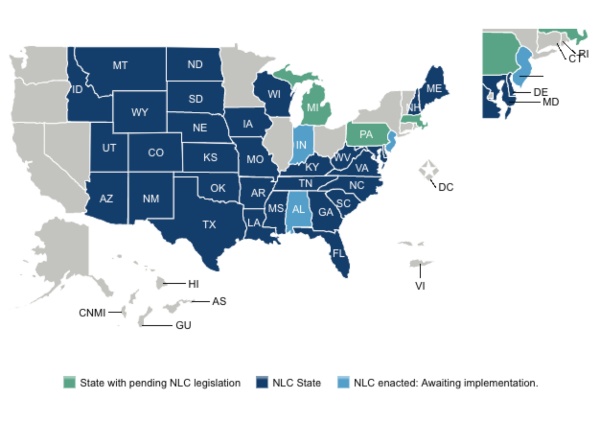
Source: National Council of State Boards of Nursing (NCSBN) 2019
You must claim residency in an eNLC participating state in order to apply for a compact license. (Your primary residence refers to the state where you file your tax returns, vote, and/or have a driver’s license.) As a non-resident of an eNLC state, you can apply for licensure by endorsement, but will only be issued a single-state license instead of the compact license. Nurses can hold multiple single-state licenses.
This may be confusing, so here are a couple examples:
Example #1: A nurse has primary residence and obtained their license in the state of Colorado, but wants to take a travel nursing job in Arizona. Because Colorado and Arizona both participate in the eNLC, there is no need to obtain an additional nursing license — the nurse can start the position in Arizona immediately. (The nurse’s current licensing information is confirmed by the employer from a national database known as Nursys and the nurse is required to complete a criminal background check and fingerprinting for the state of Arizona.)
Example #2: A nurse has primary residence and licensure in Kentucky, but wants to take a travel nursing job in Alaska. Kentucky participates in the eNLC, but Alaska does not. The nurse must obtain a single-state license for Alaska before starting their assignment.
Pro tip: If you know the specific state you’d like to travel to, then visit its state board of nursing website or ask your recruiter about licensing in that state specifically.
Travel nurse staffing agencies may refer to some states as “walk-through states,” which refers to states that issue licensure by endorsement or “temporary licenses.” Temporary licenses are mainly used for nurses who are looking to move to another state or have accepted a job and are waiting for their permanent licensing application to be processed. These types of licenses are often used during nursing strikes too. For example, obtaining a license in California can take several months, but temporary licenses are processed more quickly, so demand for nurses during strikes can be met.
Read more: Crossing the Picket Line as a Travel Nurse
Temporary licenses are typically good for 30 days to six months. If the nursing assignment is longer than the length of the temporary license, then a permanent license is required. Temporary licenses can only be obtained once per state and not all states allow temporary licenses.
Current “walk-through” states include:
The licensing fee and requirements for licensure by endorsement and permanent licensing are similar. Those fees and requirements include:
Note: Some states also require two letters of reference and proof of work history when applying for licensure by endorsement.
Travel nursing agencies typically do not pay for nursing licenses or license renewals. They will often assist in the process though, and may even submit the paperwork.
While individual state nursing boards do not require certifications such as Basic Life Support (BLS) and Pediatric Advanced Life Support (PALS), hospitals do require nurses have these certifications. That means travel nurse staffing agencies will require that these certifications be up to date before submitting your travel nurse contract to a hospital.
The cost of licenses can add up quickly for travel nurses especially when working in states that don’t participate in the eNLC.
Pro tip: Somes states allow nurses to suspend their license for a nominal fee; to reinstate the license, it’s another small fee.
For example, if a nurse holds a primary nursing license in Washington and wants to take a travel nursing assignment in Oregon (neither of which participate in the eNLC), then they must apply for a permanent license in Oregon. To obtain a single-state license, the nurse must fill out an application, pay the licensing fees, and complete a background check and fingerprinting — this process may take several weeks.
If the same nurse wants to renew their Oregon license after two years, then they must complete the required continuing education hours and pay the renewal fees. Technically, this nurse should also maintain their Washington nursing license too as it’s their primary residence. This means paying the renewal fees and completing any continuing education requirements for Washington as well.
Obtaining a nursing license can be as quick as two days in states like Hawaii or as long as six months in California or Ohio. (California and Ohio currently have the longest wait times for a permanent license.) Travel nurses may have to take contracts in other states while they wait for their license to be approved. It’s important to plan ahead if there are non-compact states on your desired list of places to travel. Typical wait times for nursing licenses for non-compact states:
If working as a travel nurse and figuring out licensing still seems daunting, don’t fret. Travel nurse agencies and recruiters are knowledgeable on the topic and in some states can help nurses expedite the licensing process.
Nurses with compact licenses have increased flexibility and can start new contracts immediately in other compact states with minimal paperwork and fees. This opens the door for more employment opportunities for nurses. The impact of the eNLC extends beyond the flexibility for nurses, though. It also increases the access to care for patients and allows hospitals to hire the best nurses for a position by removing the limitation of geographical licensures.
If you’re considering travel nursing, then ensure your license is up to date and get ready for your next adventure.
Speak to a recruiter today to find travel nursing assignments near you!
Imagine spending an entire 13 weeks taking care of ETOH withdrawal patients and then having to float to the telemetry unit for half of your shifts. As an ICU nurse, this is absolutely your worst nightmare.
So are nightmare scenarios like this what you can expect as a travel nurse? Below, we’ll explain why this isn’t what you should expect as a travel nurse — and why this common misconception shouldn’t keep you from travel nursing.
Click here to find available travel assignments.
Don’t get me wrong, becoming a travel nurse will definitely get you out of your comfort zone. There will be moments when you think you are getting the worst assignments but who in the world of nursing has the best assignments for 13 weeks in a row? That never happens…ever!
Some of your assignments may seem quite intense, but that is only because you are out of your comfort zone. You’re in a new city, you don’t know the doctors, maybe the nurses aren’t as helpful as you are used to or finding supplies is almost impossible. If you were back at home, that assignment would be no problem.
In fact, the charge nurses tend to give travelers the easiest patients. They aren’t really familiar with your skills and most of the time their own staff needs the experience with the more critical patients. You will often times find yourself in a 12 hour day full of boredom. Yes, I said the “B” word.
New travel nursing jobs available here.
One of my concerns before traveling was that I was going to lose my skills. As a staff ICU nurse I was used to taking care of the sickest of the sick. I knew all the modalities, CRRT, balloon pumps, Swans, and all of the protocols.
I knew that as a traveler, I would not be assigned these patients. What I came to find out was that I enjoyed the break from the critically ill patients. I learned to connect with my “Walky Talkies” and actually enjoyed taking care of them.
I was so used to my intubated and sedated patients that I think I lost touch with my bedside manner a little bit. I also learned that patients are virtually taken care of the same throughout the country so when I came back to my staff nurse position, it was fairly easy to get myself reoriented back into the different modalities.
Explore the country while getting paid! Find assignments in your dream city here.
If floating is what concerns you the most, then it may be wise to either prepare yourself beforehand by floating in your current hospital or choose assignments that do not float their travelers.
During my first five years as a staff nurse, prior to traveling, I only floated to a telemetry floor once. I walked around the entire night peeking into my patient’s rooms to make sure they were breathing. It was the most nerve racking experience of my life.
The thought of spending an entire travel assignment floating made me cringe. To my surprise, I really didn’t have to float that much. When it comes to staffing, travelers are definitely the first to float so there is a good chance that you will have to float some time in you travel nursing career, unless you work in a specialty area like the Cath lab or OB. I personally only floated a few times with each assignment.
The worst part of floating is that you don’t know where anything is. The patients are exactly the same… for the most part. You just might have more of them. I personally found floating to the tele floor quite easy. I often wondered why half these people were in the hospital to begin with. Learning to float and being flexible is a skill; a skill that is only mastered by a few and tends to pay off financially if you become a float pool staff nurse.
If floating sounds absolutely horrible to you then it may be wise to sign contracts that ensure you don’t float. I’m not exactly sure if these exist but you can always ask your recruiter. You can also travel to places that are known to have busy seasons when floating is less common. When you have your interview it may be good to ask about the floating situation on that particular unit. If they tend to float their nurses a lot, then maybe you can pass that one up.
Discover new travel assignments in your specialty here.
Whether or not you have a good experience as a travel nurse is up to you. If you change your perspective on who you consider to be the worst patient or how you feel about floating to another floor, then your traveling work life will be much more enjoyable.
There are important lessons to be learned from putting yourself in uncomfortable situations. You will learn to have more empathy for your fellow nurses who care for 5-6 patients at a time, you will learn to connect to your talking patients and their families, you will become more flexible and in the end, a more desirable candidate for hire. Do not be discouraged by other perceptions, instead, create your own.
Travel nursing can give you the opportunity for adventure and career development. Travel healthcare professionals typically receive competitive travel nursing pay along with a housing stipend, healthcare and travel reimbursement.
So if you’re a registered nurse who is ready to dive into the world of travel nursing, speak with a travel nurse recruiter who can help you find a travel nursing assignment that’s right for you.
Travel nursing agencies can help you make an informed decision about your travel contract, pay package and the nursing job market. Plus, a travel nursing company can help you negotiate for the best possible compensation.
New travel nursing jobs available here.
You may have encountered a travel nurse at work, or if you are like me, have wanted to be a travel nurse since before you even entered nursing school. You have also probably heard some horror stories and common misconceptions that go along with the travel nursing profession that have made you think twice about whether or not you are up for the task.
Many of these fears and misconceptions are mostly rooted in hearsay and are in need clarification. But travel nursing has lots of perks. Here’s why you shouldn’t let those stories keep you from taking a travel nursing assignment.
Start your travel career here!
The best way to ease the fear of change is to educate yourself and be prepared. Lets address some of the more common concerns:
Speak to a staffing agent today.
There are fears and there are misconceptions. Fears are created from the unknown and misconceptions are rooted in hearsay. I heard numerous horror stories and travel nursing tales prior to starting my first assignment, but I also heard of amazing experiences so I took the misconceptions with a grain of salt.
According to pantravelers.org, there is an estimated 15,000 travel nurses actively working in the US. I figured if they could do it, it must not be that bad.
Some common misconceptions/myths about travel nursing include:
See the country while doing what you love!
Like with any profession, being a traveling nurse has its benefits and downfalls. If you are bored with the same mundane routines and are looking for something a little more challenging and exciting, then a travel nursing career is right for you. The money is great but the experiences are even better.
You will learn and see things that you would never otherwise get to partake in as long as you stay in your comfort zone. If being comfortable is where you prefer to be, then a permanent staff job may be the right thing for you.
Don’t let fears and misconceptions prevent you from experiencing your personal and professional life to its fullest. Be prepared, get educated and create your own travel nursing tales.
Travel nursing agencies can help you navigate the world of travel nursing jobs. They can help you find the best travel nurse assignments and even help you negotiate your pay package.
Travel nurses typically enjoy lots of incentives, including higher pay, a housing stipend, healthcare and travel reimbursement — all while gaining valuable nursing experience and making new friends.
So if you’re ready to start enjoying the benefits of travel then talk with a staffing agency today.
Talk with a recruiter about a new travel assignment today!
As a travel nurse, you have a unique opportunity to negotiate your pay and compensation in a different way from traditional staff nursing positions. Your agency may be able to help you get additional compensation since they’re responsible for helping the hospital find the best nurses.
Discover your dream travel assignment here.
After all, an agency wants to make sure it’s bringing qualified, compensated nurses to the table so that both hospitals and nurses are satisfied. In short, it benefits everyone involved when you know your worth as a travel nurse and are compensated accordingly.
Here are some tips to help you negotiate when taking on a travel nurse position.
First, it’s to your benefit to take the time to establish your worth as a travel nurse. That may require taking on a few contracts so you can get a feel for how different agencies and recruiters work, how pay contracts are structured and the type of compensation that matters most to you. For instance, do you prefer a higher base wage and less benefits? Or do you prefer more extensive benefits and a lower base wage?
Get to know the “lay of the land,” so to speak. Most importantly, show your recruiter and agency you’re serious about a career in travel nursing so you can feel confident when negotiating future assignments.
Every travel nurse will have different values that will make certain assignments and packages more desirable. Dollar-for-hour comparison isn’t everything and it’s perfectly fine if other compensation aspects are more important to you. For instance, if gaining certain experience in exchange for a slightly lower wage makes sense for you, go for it!
You might choose to prioritize staying local or prefer assignments in far away destinations you’re eager to visit. Know what’s important to you so you can ask for the benefits that will make the assignment worthwhile for you.
Travel nursing is a competitive space for recruiters, so do some research into what contracts are offered by other agencies to help guide you in accepting or negotiating a position. If an agency is offering significantly more or less, you can use that as a bargaining tool to try to get the wages and compensation to make a contract more attractive.
Speak with other travel nurses and do research into online positions or travel nurse groups to compare different wage and benefits packages that may be similar to your offered contract. Most travel nurses are more than willing to discuss a breakdown of pay, and give advice on which agencies are helpful to work with.
If you’re negotiating a travel nurse contract, it can be helpful to know what communication style you feel the most confident in — and what your nurse recruiter prefers. If your recruiter insists on speaking via video chat every time you interact, but the thought of talking on video makes you want to run away, perhaps another vehicle of communication is more appropriate for you.
You can utilize online resources to uncover your communication style and if you’re aware of your preferred mode of communication, don’t be afraid to stick to it. If you want to talk to your recruiter via email or prefer written communication, present that in your negotiating. Send an email outlining your requests and your communication preferences.
For example, you can say: “Thank you for your time and consideration. For further discussions or decisions, I ask that you please email me as I will be unavailable via phone or phone chat for the time being.”
It’s also worth noting that it may be helpful to consider some version of compromise when it comes to negotiating. If your recruiter’s communication style differs significantly from yours, they may need to see you or talk to you to establish a working relationship of trust, so it may take some give-and-take and learning what works best for you. Consider scheduling an initial video call, followed by outlining your requests and any follow-up communication via email.
Speak with a recruiter about available travel nursing assignments.
If you have any speciality experience or certifications, use them! Additional certification in speciality areas, whether it’s critical care or neonatal resuscitation, can and should be compensated accordingly. Healthcare facilities utilizing travel nurses need additional help and finding qualified specialists is usually more challenging than finding general healthcare workers, so speciality travelers may be able to negotiate a higher rate.
Specialty experience outside of specific certification can also help you earn higher wages. For instance, if you have extensive COVID unit experience, that should definitely give you more negotiating power when taking on an assignment for a facility in need of COVID nurses.
If you don’t have a speciality certification yet, consider adding one in your field or one that you’re passionate about pursuing in the future. Certifications can boost your resume and help you expand your skills — and it only take a little while to earn them. You can even talk to your recruiter to see if there are any compensation opportunities to help get the cost of certification covered.
Nurse recruiters are people, just like you, and sometimes you might find a recruiter who doesn’t “mesh” with you. That’s OK! That doesn’t mean anything negative about either you or the recruiter. It just means you may need to try working with a few different recruiters before you find one who works well with you.
The good news is, once you do find a recruiter that you work well with, you can build a relationship of trust and your recruiter can help advocate for you and your worth.
If you are a traveling nurse with a consistent track record, a positive work ethic and a willingness to take on new assignments, a recruiter will want to continue working with you. A positive working relationship is a good thing for both of you. So once you’re established, speak openly and honestly with your recruiter about ways you can both work together to ensure that you are taking on assignments that meet your worth as a nurse.
While it may not always be effective to march into your nursing agency’s office and ask for more money, it may be possible to receive additional compensation in other ways. For instance, your agency may be able to grant specific requests that can add to your pay outside of base wages.
For instance, if you want an increased housing allowance or would like a stipend for travel, ask for it. Need a meal delivery service because you’re working in a COVID unit and don’t want to expose others? Speak up!
You can ask for compensation for a lot of additional expenses you may not have considered, including public transportation passes, uniform expenses, licensing fees, continuing education classes, moving services, or Internet and phone costs. If you’re specific about the resources you need, a recruiter can more effectively advocate on your behalf.
Discover your dream travel assignment here.
If you already meet the requirements to become a travel nurse and are ready to take the plunge, here is a step-by-step guide to getting your travel nursing career started.
Ready to start your traveling? Start here.
There are hundreds of travel nursing companies out there. If you know anyone who has traveled or is traveling you can ask them which staffing agency they worked with and what their experience was like.
HighwayHypodermics.com is a great website that rates traveling healthcare companies based on their reviews and their benefits offered.
Once you’ve familiarized yourself with a few companies, it’s important to know how to pick the right one for you. The two companies I traveled with, Cross Country TravCorps and HealthCare Pros aren’t on the list and I had a great experience with both.
Once you pick a travel nurse agency, an agent will be assigned to you. Feeling comfortable with your recruiter is of utmost importance. If they give you a bad vibe or you feel like they don’t have your best interest in mind then you can always request a different agent.
Your travel nurse recruiter is responsible for finding your assignments, making your contracts, setting up your interviews, and securing your housing. They are your lifeline so it is important to have someone who is on point.
All travel nursing companies will have you fill out a skills checklist right away. This will give them a good idea of where they can send you. The hiring managers will also look at this to make sure you are a good fit for the assignment. Keep in mind that the more skills you have, the more hirable you will be. You will also need a copy of your nursing license, driver’s license, immunizations and any certifications that you may hold.
Explore the country while doing what you love! Click here to connect with a staffing agent.
As a new travel nurse, your job options may be limited only because you lack travel nursing experience. If you have always wanted to travel to Hawaii and there are no assignments for inexperienced travel nurses, then you may have to go somewhere else first to get started on your career path.
Make sure your agent knows where you want to go and check the travel nurse job boards frequently. Some agents may try to send you somewhere with a nursing shortage, even if it’s somewhere you don’t necessarily want to go because they make more money for filling a particular open assignment.
Once you have decided where to go, you should make sure you have the proper licensure to practice in that state. If you are lucky you will have a compact license. The nurse licensure compact allows you to travel to multiple states without having to get a new state license for each one. If this is not an option for you, then obtaining a nursing license will be your top priority.
Obtaining a license usually involves filling out an application, getting fingerprints done, a background check and paying a fee. It can take upwards of a month depending on where the nursing assignment is located so be prepared to wait a little bit.
There are a few states that are considered “walk-through” states meaning that you can obtain a temporary nursing license from them in one day. The licenses are good for 30 days to 6 months depending on what state it is. These types of licenses are used mostly for “strike” work. Your staffing agent will be able to direct you on which license to obtain and how to do it.
Take your skills on the road – start your travel adventures today.
It is important that you pick a travel nurse assignment that fits your skill level. If you don’t have critical care experience, then don’t pick a critical care assignment. Starting a new job is stressful enough and not knowing what you’re doing will make it all that much harder. If you know the night shift is not your thing then pick a dayshift assignment.
Try to find a hospital that is used to having travelers. It may be wise to take your first assignment in a facility that is similar to the one you are currently working in. You can always work your way up to the 600 bed teaching facilities later in your career unless of course you are used to that type of thing.
Of course, you’ll have to choose the pay package that appeals to you most and whether the assignment includes benefits like health insurance. And consider location! Make sure that your new city is a place you’ll feel comfortable exploring.
Most travel companies have a nursing supervisor on staff that you “interview” with. There will be some hospitals that require you to speak with the nursing manager of that particular unit. “Interview” can be a scary word to some folks, but it means something a little different in the realm of travel nursing.
These “interviews” are usually conducted over the phone and mainly cover what types of patients the unit takes care of, what color scrubs they wear, how they do their staffing and scheduling, floating requirements, and go over any vacation requests you might have.
This process is more for you to determine if this travel nursing job is the right fit for you. It is important that you are flexible and open-minded when considering assignments. You are there to fill a need.
Discover your dream travel assignment here.
For registered nurses ready to launch their travel nursing careers, flexibility is the most valuable skill you can offer. Your role as a travel nurse will be very different from a staff position. You will be placed in challenging situations that require patience and understanding. You will be asked to float in the middle of your shift or work on a unit that you have never been to before. “Go with the flow” will be your new mantra.
Getting into travel nursing is a piece of cake. It’s just choosing where to go — from small towns to big cities — that is the challenge!